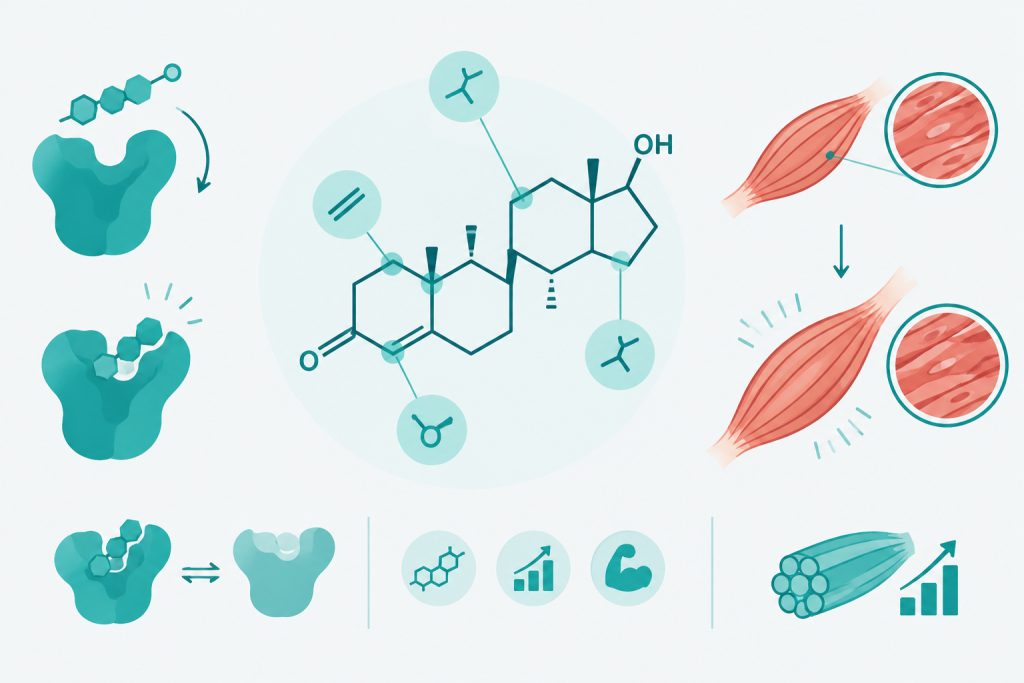
Not all anabolic-androgenic steroids behave the same way in the body. If you have ever looked at compound profiles, you have probably noticed that some molecules are described as mildly anabolic while others are called strongly anabolic. The difference is not just marketing. It reflects how each molecule interacts with androgen receptors, how long it remains in the bloodstream, and how much of its effect is directed at muscle tissue rather than other androgen-sensitive tissues. This article examines what can make one steroid more anabolic than another, drawing on pharmacology research and clinical data.
- Anabolic means building complex tissue from simpler molecules; in muscle, growth depends on the balance between protein synthesis and breakdown.
- Small structural changes to testosterone can alter receptor binding, metabolism, half-life, and tissue selectivity.
- A compound’s myotropic effect, anticatabolic action, and individual response matter as much as raw receptor affinity.
- Laboratory potency ratings do not translate directly into real-world muscle gains.
What Does ‘Anabolic’ Actually Mean?
In metabolism, anabolism is the set of pathways that build complex molecules from simpler ones, using energy. Catabolism does the opposite: it breaks molecules down to release energy. In skeletal muscle, the net result of these opposing forces determines whether tissue is gained, lost, or maintained. A positive protein balance means synthesis has outpaced breakdown over days and weeks, and that is the fundamental condition for hypertrophy.
Skeletal muscle grows when contractile proteins, mainly actin and myosin, are added to existing fibres. Resistance training provides the primary stimulus by activating mechanistic target of rapamycin complex 1 and other signalling pathways. Hormones and nutrients then modulate how much new protein is made. A compound is described as anabolic when it tilts this balance towards synthesis, either by increasing the rate of muscle protein synthesis or by reducing the rate of muscle protein breakdown. However, without a sufficient training stimulus and adequate protein intake, raising synthesis alone will not produce lasting growth.
Potency is not the same as the concentration of testosterone in blood. Blood levels tell you how much hormone is present, not how strongly a given tissue responds. True anabolic potency combines receptor-binding affinity, the ability to activate gene transcription, the ratio of muscle to non-muscle effects, and how long the active molecule remains available. Two steroids can produce similar serum concentrations yet yield very different tissue outcomes because of these additional variables.
Structural Factors That Determine Anabolic Strength
Natural testosterone serves as the chemical template for virtually all anabolic-androgenic steroids. Medicinal chemists alter the four-ring steroid nucleus to change how the molecule is absorbed, metabolised, and recognised by receptors. Adding a methyl group at the 17-alpha position slows breakdown by the liver during the first pass, which allows the compound to be active when taken orally. Attaching a fatty acid ester at the 17-beta position creates an injectable depot; tissue and blood esterases gradually cleave the ester to release the active hormone. Removing the C19 methyl group produces the 19-nortestosterone family, which has a different shape and interacts with the androgen receptor in a distinct way. Changes to the A ring, such as adding or moving double bonds, shift aromatisation and androgenic activity. The review by Kicman provides a comprehensive overview of these modifications and their pharmacological consequences here.
Binding affinity measures how tightly a steroid fits into the ligand-binding pocket of the androgen receptor. A higher affinity means the receptor can be occupied at lower circulating concentrations, but affinity alone does not determine how strongly muscle-building genes are turned on. After binding, the ligand-receptor complex recruits coactivator or corepressor proteins and binds to DNA at androgen-response elements. The availability of these helper proteins differs between tissues, so the same steroid can have stronger transcriptional effects in one cell type than another. In addition, local enzymes such as 5-alpha reductase and aromatase convert testosterone into dihydrotestosterone and oestradiol, respectively; synthetic compounds may resist these conversions or be converted into metabolites with different activity profiles. These factors create tissue selectivity, meaning that anabolic effects in muscle can be partially separated from androgenic effects in skin, prostate, or vocal tissue.
Testosterone itself is cleared relatively quickly. Structural changes can slow metabolism by 5-alpha reductase, aromatase, or hepatic enzymes. A longer half-life produces more stable plasma concentrations, but it does not increase the intrinsic potency of the molecule at the receptor. For example, 17-alpha alkylation protects the steroid from hepatic deactivation but is associated with increased hepatotoxicity. Esterification changes the release rate from the injection site without altering the activity of the parent hormone once it is released. Some compounds bind tightly to sex hormone-binding globulin, which reduces the free fraction available to tissues. The overall biological effect therefore depends on intrinsic activity multiplied by free concentration and duration of exposure.
| Structural change | What it does | Typical consequence |
|---|---|---|
| 17-alpha alkylation | Adds a methyl group at carbon-17 to slow hepatic breakdown | Oral activity; increased hepatotoxicity risk |
| Esterification at C17-beta | Attaches a fatty acid ester to create a depot | Longer release from the injection site; altered half-life |
| Removal of the C19 methyl group | Changes the steroid backbone shape | Shifted receptor binding and tissue selectivity |
| A-ring modifications | Alter double bonds or add heteroatoms | Changed anabolic/androgenic balance and aromatisation |
Why Some Steroids Build More Muscle Than Others
Researchers separate muscle-building effects from masculinising effects by using the terms myotropic and androgenic. The classic Hershberger assay compares the growth of the levator ani muscle with the growth of the prostate and seminal vesicles in animal models. A compound that produces a large increase in levator ani weight relative to prostate growth is said to have a favourable anabolic-to-androgenic ratio. This ratio is one reason some steroids are described as more anabolic than others. However, the assay is an animal model, and human tissues differ in enzyme expression and receptor cofactor content, so ratios are better viewed as a rough guide than as a precise prediction.
The best-known mechanism is genomic: the steroid enters the cell, binds the cytosolic androgen receptor, and the complex moves into the nucleus, where it regulates transcription of target genes. Because protein synthesis takes time, measurable changes in muscle mass appear over weeks. In addition to this slow pathway, steroids have been reported to produce rapid non-genomic effects through membrane-associated signalling, interactions with sex hormone-binding globulin receptors, and activation of kinase cascades. These effects may influence calcium handling, vasodilation, and recovery within minutes to hours. Their contribution to long-term hypertrophy is harder to quantify, but they may add another layer of difference between compounds.
Net muscle gain depends on synthesis minus breakdown. Some anabolic-androgenic steroids may reduce muscle protein breakdown by interfering with glucocorticoid signalling or by opposing the catabolic effects of cortisol in skeletal muscle. By lowering breakdown, they may improve net protein balance even if the increase in synthesis is modest. This anticatabolic component is part of why raw receptor affinity does not fully explain which compound produces the most muscle growth in practice. At the same time, altering glucocorticoid activity has wider metabolic and immune implications that should not be ignored.
Are Anabolic Steroids Different Than Testosterone?
Endogenous testosterone is produced by Leydig cells and serves as the body’s primary androgen. When administered exogenously, it raises circulating androgen levels but remains a substrate for 5-alpha reductase and aromatase, so tissues with high levels of those enzymes will see increased dihydrotestosterone or oestradiol. In classic assays, testosterone is often used as the reference for an anabolic-to-androgenic ratio of roughly one to one.
Nandrolone is created by removing the C19 methyl group from testosterone, producing a 19-nortestosterone backbone. This change alters receptor binding, and 5-alpha reductase converts nandrolone to a less potent metabolite in some tissues. Oxandrolone is derived from dihydrotestosterone and includes a 17-alpha methyl group and an oxygen atom in the A ring; it resists aromatisation and is active orally. Methandienone combines a C1-C2 double bond with 17-alpha methylation. Each of these changes redirects metabolism, receptor interaction, and duration of action, which is why pharmacologists can tune a compound’s profile. The structural principles are discussed in detail by Kicman here.
It is also worth remembering that some synthetic steroids act as prodrugs. The esterified injectable forms are not active until the ester is cleaved, and some oral compounds undergo hepatic conversion into more or less active metabolites. The molecule listed on the label is not always the molecule acting at the receptor.
Modified steroids can be designed to resist conversion into certain metabolites or to bind the androgen receptor in a way that favours muscle tissue. The result is not simply more muscle everywhere; it is a shifted pattern of effects and side effects. Reduced androgenicity in one tissue does not automatically mean reduced androgenicity in all tissues, and some compounds produce active metabolites that change the final outcome. If you want to compare specific molecules, our site offers a detailed breakdown of individual compounds and their receptor profiles.
Clinical Evidence on Anabolic Effects and Limitations
Controlled trials have reported dose-dependent increases in fat-free mass and muscle performance with testosterone administration. In a well-known ten-week study by Bhasin and colleagues, testosterone enanthate was associated with increases in fat-free mass, quadriceps cross-sectional area, and bench-press strength; larger doses produced larger average changes here. These findings established testosterone as a practical reference against which other compounds are compared. Other controlled studies using similar designs have generally reported increases in lean mass, though individual responses vary substantially.
Cumulative exposure to anabolic-androgenic steroids has been associated with unfavourable shifts in lipid profiles, changes in left ventricular structure and function, blood pressure alterations, and other cardiovascular concerns. Oral 17-alpha alkylated compounds can affect liver enzymes and markers of hepatocellular stress. Endogenous testosterone production is typically suppressed during use, and dermatological changes, mood disturbances, and reproductive hormone disruption have also been reported. A recent review summarised cardiovascular and metabolic risks linked to exposure here. Kicman also covers hepatotoxic, cardiovascular, and endocrine adverse effects associated with these compounds here.
High receptor-binding affinity and a favourable anabolic-to-androgenic ratio do not guarantee larger muscles in a specific person. Real-world outcomes may depend on the quality and consistency of resistance training, total protein and energy intake, sleep, stress, genetically determined androgen-receptor expression, baseline hormone levels, satellite-cell activity, myostatin expression, and the ability to tolerate a given dose without unacceptable side effects. A compound that looks powerful on paper may be limited in practice by water retention, androgenic side effects, or individual non-response. Potency ratings are therefore one piece of information among many.
References
- Kicman AT. Pharmacology of anabolic steroids. Br J Pharmacol. 2008;154(3):502-521. https://pubmed.ncbi.nlm.nih.gov/18500378/
- Bhasin S et al. The effects of supraphysiologic doses of testosterone on muscle size and strength in normal men. N Engl J Med. 1996;335(1):1-7. https://pubmed.ncbi.nlm.nih.gov/7551381/
- Cardiovascular and metabolic risks of anabolic-androgenic steroid exposure. https://pubmed.ncbi.nlm.nih.gov/40880090/
Disclaimer: This article is for informational purposes only and is not a substitute for professional medical advice, diagnosis, or treatment. Talk to a qualified healthcare provider before using any hormone-modulating substance, especially if you are pregnant, taking prescription medications, or have a chronic health condition. Individual results vary, and nothing in this material promises a specific outcome for any reader.