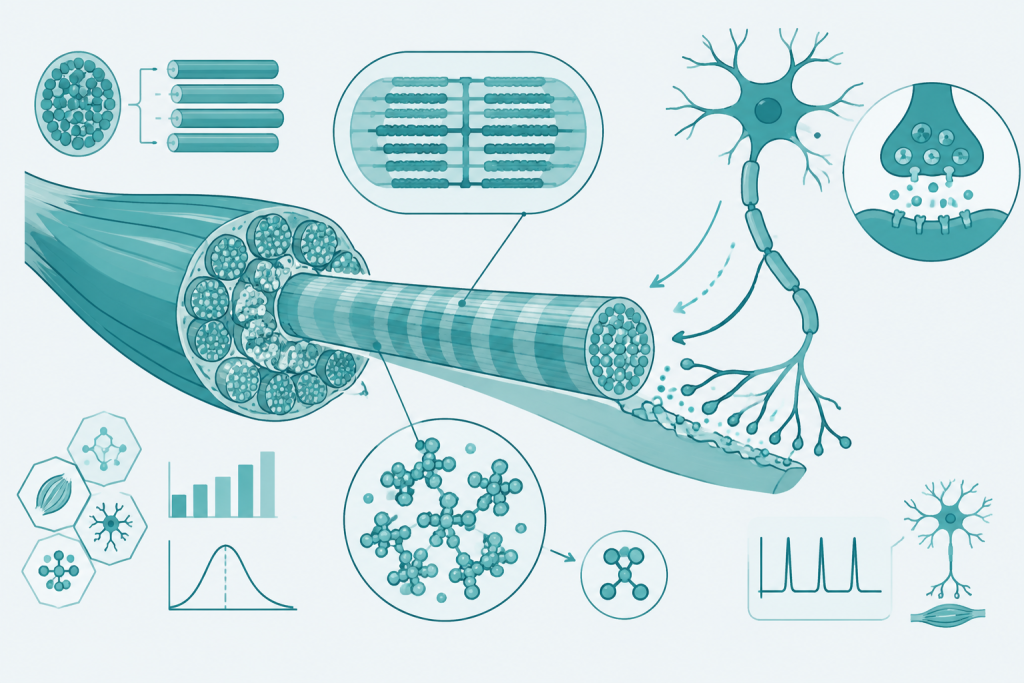
Strength and muscle size look like the same thing, but they are not. Two athletes can weigh the same and look similar, yet one of them lifts significantly more. The gap comes from what changes inside the muscle and inside the nervous system. Anabolic-androgenic steroids can influence both, yet not every compound shifts strength and size in the same proportion.
In this guide, we break down how steroids differ in their effects on raw strength versus visible muscle mass, what the available evidence suggests, and why compound selection may affect the outcome you actually want.
- Muscle size depends on fibre growth and fluid volume; strength depends on neural drive and fibre quality.
- High-androgenic, non-aromatising compounds are often described as favouring strength relative to scale weight.
- Testosterone-based, aromatising compounds may add more total mass because of oestrogen-mediated water and glycogen retention.
- Training style, diet, and recovery still influence whether gains show up as strength, size, or both.
What is the difference between muscle size and strength?
Before comparing compounds, it helps to separate the two outcomes people often lump together. Muscle size is the physical cross-sectional area of a muscle. Strength is the force that muscle can produce. They overlap, but they are not the same measurement.
Muscle hypertrophy vs neural adaptations
Muscle hypertrophy means an increase in the size of individual muscle fibres. It happens when protein synthesis exceeds breakdown over time, usually driven by mechanical tension, metabolic stress, and recovery. Bigger fibres have the potential to produce more force, but only if the contractile machinery grows along with them.
Neural adaptations happen in the central nervous system. Your brain and spinal cord learn to recruit more motor units, fire them faster, and reduce protective inhibition. A smaller muscle with better neural drive can produce more force than a larger muscle with poor recruitment. This is why beginners get stronger quickly without adding much size, and why some experienced lifters stay relatively small but lift huge weights.
Sarcoplasmic vs myofibrillar growth
Not all growth is identical. Sarcoplasmic hypertrophy increases the fluid, glycogen, mitochondria, and enzymes inside the muscle cell. The muscle looks fuller, but the gain in actual force production may be modest. Myofibrillar hypertrophy increases the number and density of contractile proteins. This type of growth contributes more directly to strength.
Training style nudges the balance. Higher-rep, metabolically demanding work tends to expand sarcoplasmic volume. Lower-rep, high-load work tends to drive myofibrillar adaptations. Steroids can amplify either path, but they do not replace the signal that training sends.
Why size and strength don’t always correlate
A bodybuilder and a powerlifter can have similar amounts of muscle on paper but very different strength numbers. The bodybuilder may have more total cross-sectional area and fluid-filled volume, while the powerlifter may have denser contractile tissue and better technique. Leverages, tendon insertion points, and muscle architecture also matter.
So when we talk about steroids for strength versus steroids for size, we are really asking which compounds may favour dense, force-producing tissue, and which ones may contribute to fuller, heavier tissue.
How do steroids differ from each other?
Anabolic-androgenic steroids are not one uniform drug. They share a common mechanism—they activate the androgen receptor—but their chemical structures create very different downstream effects. For a full breakdown of each compound class and their specific effects, see our compound library.
Androgenic vs anabolic ratio
Laboratory ratings compare steroids to testosterone as a reference. The “anabolic” rating estimates tissue-building activity, while the “androgenic” rating estimates effects on male characteristics. These numbers come from animal models, not real-world athletes, so they are a starting point rather than a guarantee.
A compound with a high anabolic rating does not automatically build more muscle in humans. Protein binding, metabolism, aromatisation, and individual response all change the outcome. Still, the ratio gives a rough idea of whether a steroid leans more towards tissue growth or towards androgen-related effects, including possible changes in training response and water-retention patterns.
Difference between testosterone and synthetic steroids
Testosterone is the natural reference point. Synthetic derivatives are altered to last longer in the body, resist breakdown, or avoid conversion into oestrogen or DHT. Some derivatives are close to testosterone and aromatise readily. Others resist aromatisation and behave more like dihydrotestosterone.
These differences help explain why two steroids can produce different physiques at similar doses. One may leave the user fuller and heavier because of water retention, while another may produce a drier, harder look with less change on the scale.
Aromatisation and water retention properties
Aromatisation is the process by which testosterone converts into oestradiol. Oestrogen has roles in several physiological processes, but higher oestrogen activity can also increase extracellular water retention and glycogen storage. That extra water shows up as size and scale weight, even if it is not new contractile tissue.
Non-aromatising steroids do not convert to oestrogen at meaningful levels. They typically produce less water retention, so the scale moves less, but strength can still improve because the androgen receptor is still activated and neural drive may also be affected.
Steroids for strength vs size: what the research shows
Controlled studies in this area are limited because researchers cannot ethically give high doses of steroids to healthy athletes for long periods. Much of the available evidence comes from observational studies, short-term controlled trials, and muscle biopsy work.
Lean muscle mass gains from anabolic steroid treatment
One observational report followed experienced male bodybuilders through 43 self-managed anabolic steroid cycles. During the active treatment phases, participants gained measurable lean body mass, and the gains partially reversed after the compounds were discontinued. This pattern is consistent with the extra mass being linked to continued anabolic signalling, although maintenance also depends on what happens after the cycle ends.
Muscle fibre size increase and parallel strength improvement
Biopsy studies link anabolic steroid treatment to increases in muscle fibre cross-sectional area, especially in fast-twitch fibres. Larger fibres can produce more force when the contractile proteins increase. At the same time, participants in controlled trials may train with greater intensity, which adds a neural and technique component to the strength gains.
Do all steroids increase strength equally?
No. Compounds that add significant water and glycogen can affect leverage and joint stability, which may help in the gym, but the actual contractile gain varies. A non-aromatising, highly androgenic compound may move the scale less while still improving one-rep-max performance. Conversely, an aromatising compound may add more total body weight and fuller muscles without a matching jump in maximal strength.
Source: PubMed.
Best steroid for strength not size
There is no single best choice for everyone. The compounds most often discussed for strength without excessive bulk share a few traits: they are typically strong androgens that do not aromatise, so they may increase training performance without adding large amounts of water weight.
Compounds with high androgenic effects and minimal water retention
DHT-derived compounds generally resist aromatisation. Because oestrogen activity is lower, water retention may also be lower, and the scale may not jump as dramatically. These compounds are often associated with harder, drier tissue and improvements in strength relative to body weight. They may also affect the central nervous system in ways that make heavy efforts feel more manageable.
Strength gains vs mass gains: which steroids favour neural adaptations
Highly androgenic compounds may favour the neural side of strength. They may affect motivation, training focus, and motor-unit recruitment. That does not mean they build zero muscle, but the visible size gain may be smaller than the strength gain. For athletes who compete in weight-class sports or who want to limit changes in body weight, this trade-off may be relevant.
Considerations for lean muscle building vs bulking
If your goal is lean muscle rather than maximum bulk, compound choice is only part of the equation. You also need enough protein, a modest caloric surplus or maintenance intake, and a training programme that emphasises progressive overload in moderate rep ranges. A steroid that does not aromatise will not hide a poor diet, and a steroid that does aromatise will not turn excess calories into pure muscle.
Steroid types: bulking vs cutting compounds
Bodybuilders usually group compounds into bulking and cutting categories. The labels are not scientific, but they describe the typical body-composition outcome when a compound is combined with a matching diet and training plan.
| Feature | Bulking compounds | Cutting compounds |
|---|---|---|
| Primary goal | Maximise lean mass and total body weight | Preserve lean tissue while limiting fat and water |
| Aromatisation | Often higher; more oestrogen-mediated water and glycogen | Usually lower; drier tissue |
| Typical look | Fuller, rounder, heavier on the scale | Harder, more defined, less scale weight |
| Strength effect | Leverage and joint cushioning from extra mass and water | Strength often maintained or improved gradually |
| Common chemical classes | Testosterone derivatives, some 19-nor compounds | DHT-derived compounds, non-aromatising options |
| Diet pairing | Caloric surplus with high protein | Caloric deficit or maintenance with high protein |
Advanced steroid bulking stack characteristics
Advanced bulking stacks combine aromatising compounds to increase anabolic signalling and total weight gain. The extra water and glycogen contribute to the look and may affect training leverage. The downside is that blood pressure, oestrogen management, and fat gain become bigger concerns. Diet must be tightly controlled or the stack may add more fat than muscle.
Lean muscle building steroid stack approach
A lean-muscle approach uses fewer aromatising compounds and keeps calories closer to maintenance or a slight surplus. The goal is slower tissue gain with less water retention and less fat accumulation. Strength may still improve, but the visual change is more about definition than sheer scale weight.
How compound selection affects body composition outcomes
The same training programme can produce different visual results depending on the compounds used. A bulking-oriented stack paired with a surplus may add mass faster, including water and some fat. A cutting-oriented stack paired with a deficit may help retain more muscle while reducing water and fat, but the outcome depends on the full training, diet, and individual context. The compound does not override the diet; it changes how the body responds to the diet.
Practical considerations
Can you build significant size on TRT vs supraphysiological doses
Testosterone replacement therapy restores testosterone to the normal physiological range. That can support muscle maintenance, energy, and modest gains when paired with good training and nutrition. It does not push anabolic signalling far above the natural range, so the dramatic size changes seen in some studies are generally associated with supraphysiological doses.
Building a heavily muscled physique is also a matter of genetics, years of training, and consistency. A middle-aged man on TRT can improve his physique significantly, but matching the size of a competitive bodybuilder usually requires far more than hormone optimisation.
Anabolic steroids for men over 50: risk-benefit context
Men over 50 face a different risk profile. Cardiovascular health, prostate considerations, lipid panels, and liver function become more important. Testosterone replacement may be appropriate for some men under medical supervision, but self-directed steroid use raises the chance of blood pressure issues, polycythaemia, and adverse lipid changes.
Older trainees can still build muscle, but the margin for error is smaller. Recovery takes longer, and the same dose that a younger athlete tolerates may produce stronger side effects.
What most often limits muscle gains when using steroids
Steroids amplify what is already happening, but they do not fix broken fundamentals. The main factors that can limit gains are the same regardless of pharmacology: insufficient protein, inconsistent training, poor sleep, too much stress, and excessive caloric restriction. Another common issue is skipping recovery work and adding more volume than the body can repair.
Perhaps the most underappreciated factor is post-cycle nutrition and training. When anabolic signalling drops, muscle tissue may be at risk if calories, protein, and training drop at the same time. Keeping the fundamentals steady is more likely to support long-term progress than relying on a temporary spike.
This content is for informational purposes only and is not medical advice, a diagnosis, or a recommendation to use any substance. Talk to a qualified healthcare professional before making decisions about hormones, especially if you are pregnant, taking medications, or have a chronic condition. Individual results vary, and nothing here guarantees a specific outcome for you.