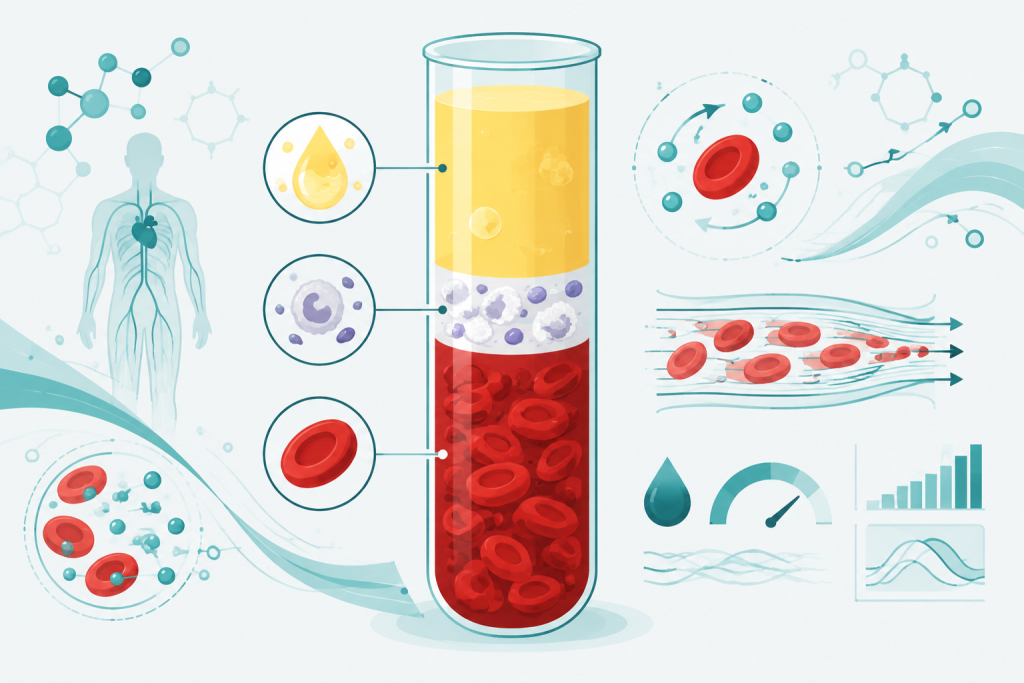
Hematocrit is one of those lab values that looks simple until it starts moving. Reported as a percentage, it tells you how much of your blood is made up of red blood cells. For most people it sits in a predictable band, but for anyone using anabolic steroids, testosterone replacement therapy (TRT), or other androgens, it can climb steadily and quietly. We cover haematocrit here, but it is only one part of the picture; see our breakdown of blood markers athletes should track for the broader panel.
- Haematocrit is the percentage of your blood volume that consists of red blood cells. Typical adult ranges are roughly 41–50% for men and 36–44% for women, though labs vary.
- Androgens can stimulate erythropoietin and the bone marrow’s production of red blood cells. That is one reason AAS and TRT may raise haematocrit.
- When haematocrit is high, blood viscosity can increase. This may contribute to headaches, dizziness and circulation problems, while the overall risk of clots and cardiovascular events depends on the level and other risk factors.
- Managing a high value may involve adequate hydration, therapeutic phlebotomy, reviewing the steroid dose or protocol, and regular testing with a complete blood count. Blood donation may be an option for some people, subject to eligibility rules.
What Is Haematocrit and Why It Matters
Haematocrit is the proportion of red blood cells in your total blood volume. If you imagine a tube of blood spun down in a centrifuge, the bottom layer is red blood cells, the middle is a thin buffy coat of white cells and platelets, and the top is plasma. Haematocrit is the percentage of the column occupied by those red cells. It is a standard part of a complete blood count (CBC) and is usually reported alongside haemoglobin and red blood cell count.
The number matters because red blood cells carry haemoglobin, the protein that picks up oxygen in the lungs and delivers it to muscles and organs. A healthy haematocrit means enough oxygen-carrying capacity without a substantial increase in blood viscosity. When the value is too low, there may not be enough red cells to deliver oxygen efficiently. When it is too high, the extra cells can increase viscosity and place more strain on circulation.
Normal ranges differ by sex, age, and laboratory method. Adult men typically fall around 41–50%, while adult women are usually around 36–44%. Women who are pregnant often run lower because blood volume expands faster than red cell mass. People living at high altitude, endurance athletes, and smokers may sit at the upper end of or slightly outside the usual range for physiological reasons. That is why a single number always needs context.
| Group | Typical haematocrit range | Why context matters |
|---|---|---|
| Adult men | About 41–50% | Muscle mass, hydration, and altitude can shift values |
| Adult women | About 36–44% | Menstrual bleeding and pregnancy commonly lower it |
| High-altitude residents and endurance athletes | Often at the upper end or slightly above | Natural EPO adaptation increases red cell mass |
| People using androgens | Often elevated above their baseline | Dose, route, and individual response vary widely |
For bodybuilders and strength athletes, haematocrit is worth watching because anabolic-androgenic steroids (AAS) can affect erythropoiesis, the production of red blood cells. A rising haematocrit may be one of the measurable changes associated with androgen use. It should be interpreted alongside symptoms, other blood results, and the person’s baseline.
How Steroids Raise Haematocrit Levels
The link between androgens and red blood cells has been recognised for decades. Androgens may raise haematocrit through several overlapping mechanisms, including effects on erythropoietin (EPO) and the bone marrow. EPO is a hormone produced mainly by the kidneys in response to low oxygen. It travels to the bone marrow and helps regulate the production of red blood cells. Androgens appear to increase EPO activity and may also make the bone marrow more responsive to its signal. The result can be a rise in circulating red cells.
Research reviewed in PMC3774012 outlines how testosterone influences erythropoiesis. The evidence points to both direct effects on erythroid progenitor cells and indirect effects through EPO, along with changes in iron handling. In practical terms, even men taking testosterone for hormone replacement may see their haematocrit drift upwards during therapy. The effect is not limited to bodybuilders using high doses.
Under normal conditions, the body regulates red cell mass. When more cells are produced, production should eventually adjust. Androgens may alter some of that feedback, particularly at higher levels, so the marrow continues producing red cells even when the count is already high. Some androgens may also affect red blood cell lifespan, although increased production is thought to be the larger contributor.
There appears to be a dose-response relationship, but it is not perfectly predictable. Therapeutic TRT doses may raise haematocrit by a few percentage points and can occasionally push a man above the reference range. Supraphysiological doses used for muscle-building may produce larger or faster increases. However, individual genetics, baseline haematocrit, age, hydration status, and the specific compound all play a role. Two people on similar protocols can end up with very different lab results.
Route of administration may also matter. Injectables can produce higher peak levels and may raise haematocrit more than transdermal preparations in some men, though this varies. Long-acting esters can produce broader fluctuations, while more frequent dosing may smooth those peaks. These are general patterns, not rules that apply to everyone.
High Haematocrit: Symptoms, Risks, and When It Becomes Dangerous
Not everyone with a high haematocrit feels it. In the early stages, the change can be silent, which is why regular blood work matters. When symptoms do appear, they may reflect increased blood viscosity or other factors affecting circulation. Common complaints include headaches, dizziness, fatigue, blurred vision or visual disturbances, ringing in the ears, flushed or itchy skin, and a feeling of pressure in the head. Some people notice shortness of breath during exertion or a general drop in endurance.
Itching after a hot shower is a recognised but nonspecific symptom reported in some people with raised red cell mass. It is not diagnostic on its own, but unexplained itching alongside an abnormal blood count is worth discussing with a clinician.
The bigger concern is what a high haematocrit may do to circulation. As the percentage of red cells rises, blood viscosity can increase. The heart may have to work harder to push blood through the vessels, and flow in small vessels may slow. This may be associated with higher blood pressure in some individuals and can add to existing cardiovascular strain.
When to seek urgent care: High haematocrit can be associated with serious events, but symptoms matter. If you develop severe headache, sudden vision changes, chest pain, shortness of breath, weakness on one side of the body, or confusion, seek emergency medical attention. These can be signs of a stroke, heart attack, or blood clot and require immediate evaluation.
The most serious concern with markedly elevated haematocrit is the possibility of clot-related complications. Increased viscosity may contribute to clot formation, especially when other risk factors are present, such as dehydration, smoking, obesity, sleep apnoea, inherited clotting disorders, or elevated platelets. Clots can travel to the lungs, brain, or heart. The level of risk varies between individuals and is one reason clinicians monitor this marker closely.
There is no universal danger number, but many clinicians become concerned when haematocrit exceeds 54% in men on testosterone therapy, and some use 52% as a threshold for review or action. Higher values generally warrant prompt medical assessment, although the appropriate response depends on symptoms, blood pressure, platelet count, underlying conditions, and overall health. In women, haematocrit in the high 40s warrants attention because their normal baseline is lower. These thresholds are guides, not absolutes.
How to Lower Haematocrit While on Steroids
If your haematocrit is climbing, the first step is to confirm the result under consistent conditions. Dehydration concentrates the blood and can make haematocrit look higher than it really is. A repeat test when you are rested and adequately hydrated can help clarify the result. Hydration may reduce the effect of concentration, but it is not a substitute for medical management if the value is genuinely high.
One direct way to lower haematocrit is to remove red blood cells from circulation. Therapeutic phlebotomy, a controlled blood draw, may be used under medical supervision. Removing blood reduces red cell mass and can bring haematocrit down, although the amount and timing should be determined by a clinician. Blood donation at a licensed centre is not automatically equivalent to therapeutic phlebotomy: eligibility rules vary, and some centres ask about steroid use or require a prescription. A therapeutic phlebotomy ordered by a doctor is generally preferable when treatment is medically indicated because it is documented and monitored.
Alongside phlebotomy, reviewing the androgen dose or protocol may be appropriate. Lowering the total weekly dose, extending the interval between injections, or switching to a preparation with more stable levels may reduce the stimulus for red cell production. In TRT, some providers switch patients from injectable testosterone to transdermal gels if haematocrit keeps rising. These changes should be made with a clinician who can track the response; abrupt or unsupervised changes can create hormonal swings.
Monitoring frequency depends on where you start and how fast things change. A sensible approach is:
- Get a baseline CBC before starting any androgen protocol.
- Recheck haematocrit after starting or changing a protocol, following the schedule advised by the prescriber.
- If stable, continue testing at the interval recommended for your treatment or cycle.
- If haematocrit is rising or near the upper limit, test more frequently until the cause and trend are clear.
Consistency matters: try to use the same lab, follow the same fasting or non-fasting approach, and be adequately hydrated each time.
Low Haematocrit and Other Blood Test Considerations
Most of the attention in the steroid world goes to high haematocrit, but low haematocrit is also informative. A low value may indicate anaemia, or a lower-than-normal red blood cell mass. Causes include iron deficiency, vitamin B12 or folate deficiency, chronic blood loss such as heavy periods or gastrointestinal bleeding, bone marrow disorders, chronic disease, and some infections. In someone using androgens, a low haematocrit is unusual and should prompt a search for an underlying problem rather than assuming the drug is protective.
Haematocrit should never be read in isolation. It is one line in a CBC, and the surrounding values give it meaning. Haemoglobin tells you how much oxygen-carrying protein is present. Red blood cell count tells you how many cells are circulating. Mean corpuscular volume (MCV) shows whether cells are larger or smaller than normal, which can help distinguish iron deficiency from B12 deficiency. Red cell distribution width (RDW) reflects variation in cell size. Ferritin, serum iron, and transferrin saturation provide information about iron stores. Platelet and white blood cell counts complete the picture. Blood pressure should also be tracked, since high haematocrit and hypertension can add to cardiovascular risk.
Context changes interpretation. Living at altitude raises haematocrit naturally. Dehydration raises the measured percentage even when red cell mass is normal. A recent illness, especially one involving vomiting or poor fluid intake, can skew results. Smoking and untreated sleep apnoea tend to push haematocrit up. The time of day, lab assay, and even posture during the draw can introduce minor variation. That is why trends over time usually matter more than a single reading.
If you are interpreting your own labs, compare each result with your previous baselines and the broader clinical picture. A haematocrit of 53% in a well-hydrated, asymptomatic man at sea level means something different from the same number in a dehydrated, headache-prone individual with high blood pressure. When in doubt, repeat the test and discuss it with a clinician who knows your full history.
Disclaimer: This article is for informational purposes only and is not a substitute for professional medical advice, diagnosis, or treatment. Talk to a qualified healthcare provider before making any decisions about androgens, blood donation, phlebotomy, or supplements, especially if you are pregnant, taking medications, or have a chronic health condition. Individual responses vary, and nothing in this article promises a specific outcome for any reader.