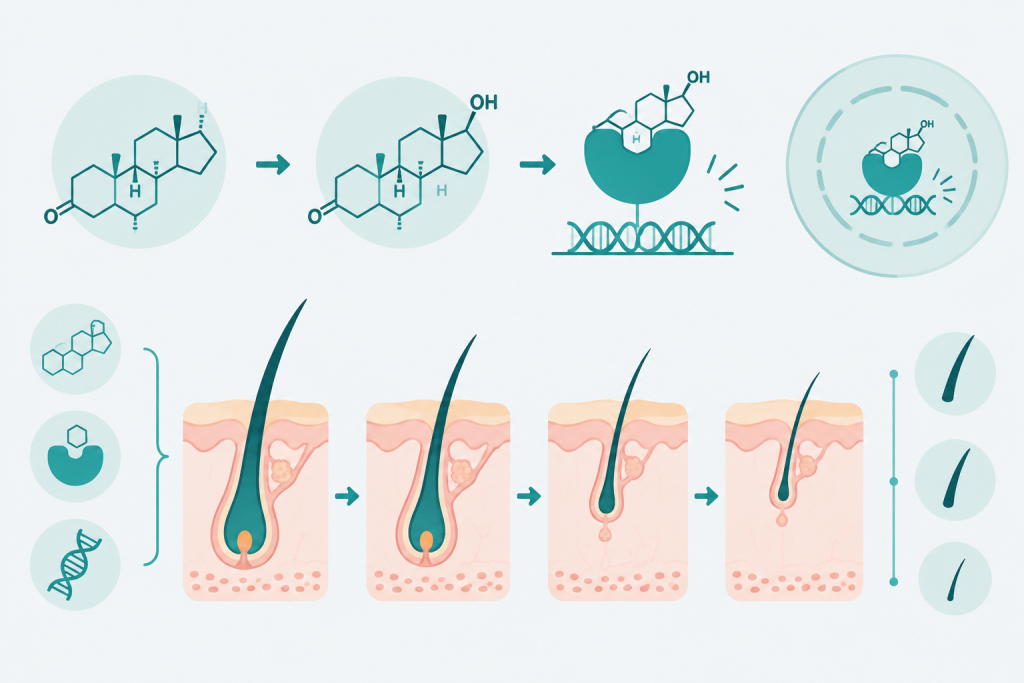
Anabolic steroids affect more than just muscle tissue. For some users, one of the first cosmetic changes they notice is hair thinning or shedding on the scalp. If you have noticed more hair in the shower drain, a widening parting, or a receding hairline after starting a cycle, the timing may be significant. The association between anabolic-androgenic steroids and hair loss has been described in medical literature and user reports, although it does not affect everyone.
Why some people lose hair while others retain a full head depends on hormones, genetics, and the compounds involved. This article outlines the possible mechanisms behind steroid-related hair loss, which compounds may carry a higher risk, how men and women can be affected differently, and whether thinning may improve after use stops.
- Steroids with strong androgenic activity may accelerate hair-follicle miniaturisation in people with a genetic predisposition.
- Testosterone, trenbolone, and DHT-derived compounds may carry a higher risk; compounds with lower androgenic activity are not risk-free but may be less likely to affect the scalp.
- Hair loss may slow or partially reverse after steroid use stops, but prolonged exposure or advanced miniaturisation can lead to lasting changes.
How Anabolic Steroids Affect Hair Follicles
Androgenic signalling is central to steroid-related hair loss. Testosterone can be converted into dihydrotestosterone, or DHT, by the enzyme 5-alpha reductase. Other anabolic steroids are chemically related to DHT or have androgenic activity without being converted into it. The enzyme is present in the scalp, skin, prostate, and other tissues. DHT and other androgens can bind to androgen receptors in scalp follicles.
That binding is a normal biological process, but in people who are genetically sensitive, sustained androgenic stimulation can contribute to hair-follicle miniaturisation. Over time, the growth phase of each follicle may become shorter, while the hairs that grow become finer and shorter. This process is associated with ordinary pattern hair loss, although the precise response varies between individuals.
Not every steroid behaves in the same way. Compounds are commonly described in terms of anabolic and androgenic activity, although these ratings do not predict an individual’s response with precision. Greater androgenic activity may mean a greater risk of accelerating hair loss in someone who is already susceptible.
Genetic differences can affect androgen-receptor activity and the way follicles respond to androgens. This helps explain why pattern hair loss often runs in families. Steroid exposure may accelerate an existing tendency, but it does not affect all users in the same way.
The main variable is individual susceptibility. Someone without a strong predisposition may notice little change, while a person prone to male- or female-pattern hair loss may see thinning sooner than expected. This is one reason two people using the same compound can report very different outcomes.
Which Steroids Are Most Likely to Cause Hair Loss
When people ask which steroids may be hardest on the hair, the relevant factors include androgenic activity, the way a compound interacts with the androgen receptor, and whether it is converted to DHT.
| Compound category | Common examples | Relative hair-loss risk | Main reason |
|---|---|---|---|
| Testosterone and compounds that can be converted to DHT | Testosterone cypionate, testosterone enanthate | Higher in susceptible users | Testosterone can be converted to DHT by 5-alpha reductase |
| Highly androgenic non-converting compounds | Trenbolone | Potentially higher | Direct androgenic activity may affect scalp follicles |
| DHT-derived compounds | Masteron, Proviron, Winstrol | Potentially higher | Structurally related to DHT and active at androgen receptors |
| Lower-androgenic compounds | Nandrolone, oxandrolone | Potentially lower, but not risk-free | Different androgenic profiles and metabolites |
Testosterone and its esters can be converted to DHT through 5-alpha reductase. That makes testosterone a possible contributor to scalp thinning in susceptible users. Trenbolone is not converted to DHT in the usual way, but it has substantial androgenic activity of its own. Masteron, Proviron, and Winstrol are DHT-derived compounds, so their activity does not depend on conversion from testosterone.
Nandrolone and oxandrolone are often described as less likely to affect hair than more androgenic compounds. Nandrolone is converted to a metabolite with different androgenic activity from DHT, while oxandrolone has a relatively low androgenic rating compared with some other oral compounds. Neither should be considered hair-safe for everyone, and individual responses remain unpredictable.
Dose and duration may also influence risk. A shorter period of exposure may be followed by limited or temporary shedding in some people, whereas prolonged or repeated exposure may place greater stress on susceptible follicles. Combining several androgenic compounds can further increase overall androgen exposure.
Individual response remains difficult to predict. Genetics, age, baseline hair density, existing pattern hair loss, and the total androgenic exposure may all contribute.
Hair Loss in Males vs. Females on Steroids
Men and women can both experience steroid-related hair loss, but the pattern and accompanying effects may differ because their usual androgen levels and hair-growth patterns differ.
In males, the typical presentation is accelerated male-pattern hair loss. If a man is already predisposed to thinning at the temples and crown, androgenic steroid use may make those changes more noticeable. The hairline may recede, the crown may thin, or the process may appear to progress more quickly than it otherwise would have.
Women can also develop androgen-related scalp thinning. Because their usual androgen levels are lower, exposure to anabolic steroids may produce a substantial hormonal change. Some women may develop a pattern of scalp thinning alongside increased facial or body hair growth, as androgen-sensitive follicles respond differently depending on their location.
The size and timing of the hormonal change matter more than a simple comparison of doses between men and women. A dose described as moderate in a male user may have a considerably different effect in a female user, and individual sensitivity varies.
Virilisation is a separate but related concern for women. A deeper voice, clitoral enlargement, and changes in facial or body hair can occur alongside scalp thinning. Some virilising changes may not fully reverse after use stops, so medical advice is particularly important before using androgenic compounds.
Hormonal recovery also varies. There is no reliable way to predict how quickly hormone levels will return to baseline after anabolic steroid use, and recovery may be complicated for both men and women. Post-cycle treatment should not be assumed to restore normal hormone production or remove the associated risks.
Is Hair Loss from Steroids Permanent or Reversible?
Whether steroid-related hair loss improves depends on the duration of exposure, the extent of follicle miniaturisation, the underlying pattern of hair loss, and other individual factors.
Early-stage thinning may be more likely to improve after exposure ends. If hormone levels return towards baseline, follicles that have only recently begun to miniaturise may resume a more typical growth cycle. Any regrowth is not guaranteed, and density may take months to change.
Prolonged exposure can lead to more lasting changes. Once a follicle has been miniaturised for a long period, it may produce only very fine hair or stop producing visible hair. Regrowth then becomes less likely and may require assessment by a healthcare professional.
Hormonal recovery does not necessarily mean hair recovery. Even if testosterone and oestrogen levels return towards baseline, an underlying genetic predisposition remains. Steroid use may reveal or accelerate a pattern that would otherwise have appeared later.
Age and existing hair loss may also influence the outcome. Someone with substantial hair density and little prior thinning may have a different prognosis from someone who was already close to a pattern of noticeable loss.
Reducing Hair-Loss Risk and Seeking Medical Advice
Anyone concerned about hair loss while using anabolic steroids should consider stopping the exposure and discussing the change with a qualified healthcare professional. There is no reliable way to remove the risk while continuing to use androgenic compounds, and switching compounds does not make hair loss impossible.
Compound choice may influence androgenic exposure, but lower androgenic activity does not make a steroid safe for the scalp. Nandrolone, oxandrolone, and other compounds are sometimes described as less likely to affect hair, but individual responses differ. You can find a full breakdown of androgenic compounds and their side effect profiles on our main site.
DHT-blocking medicines such as finasteride or dutasteride reduce the conversion of testosterone to DHT. Their effect is therefore more relevant to testosterone-related conversion than to DHT-derived compounds or highly androgenic compounds whose activity does not depend on that pathway. These medicines can have their own adverse effects and should be considered with a clinician rather than added to a steroid regimen without supervision.
Topical treatments may be used for some forms of pattern hair loss. Minoxidil is used to support the growth phase of remaining hairs, while ketoconazole shampoo may be appropriate when scalp inflammation or another scalp condition is present. The suitability and likely benefit of these options depend on the cause of the hair loss.
General scalp care can reduce additional sources of shedding. Avoiding harsh chemical treatments, reducing traction from tight hairstyles, and addressing significant stress may help protect existing hair, but these measures cannot reliably prevent androgen-related miniaturisation.
Blood tests can help a clinician assess hormone levels and other health factors, but they cannot by themselves predict whether a follicle will recover. A scalp examination is useful when shedding is persistent, sudden, patchy, or accompanied by inflammation. Do not change prescribed treatment or start a DHT blocker without medical advice.
DHT blockers and topical treatments can have their own adverse effects. Finasteride may affect sexual function or mood in some men. Minoxidil can cause scalp irritation and unwanted facial hair if it spreads to other areas. Discuss any treatment plan with a clinician before starting it.
Hair Loss on TRT vs. Supraphysiological Steroid Doses
Testosterone replacement therapy and the doses used for physique enhancement are different clinical situations, and their effects on hair cannot be predicted solely from the label applied to the treatment.
TRT is intended to restore testosterone towards a physiological range. DHT production may remain within a usual range for some patients, but it can vary with dose, individual metabolism, and treatment response. Hair loss can still occur in someone who is genetically predisposed, because ordinary androgen exposure may be sufficient to trigger thinning over time.
Supraphysiological steroid doses raise androgen exposure above the usual physiological range. This may increase androgenic stimulation of scalp follicles and may be followed by more noticeable shedding during or after a cycle. The timing varies considerably between users.
Managing DHT during TRT requires clinical monitoring rather than assumptions based on symptoms alone. A clinician may review the dose, treatment schedule, laboratory results, and hair-loss pattern. High-dose cycles and combinations of compounds can make the overall androgenic exposure more difficult to assess.
The timeline may also differ. TRT-related hair changes can develop gradually, while changes associated with high-dose steroid exposure may become noticeable over weeks or months. Neither pattern guarantees that hair will recover after exposure ends.
Research into androgenic signalling and hair-follicle biology supports an association between androgen exposure and follicle miniaturisation. For example, a review published in PMC discusses the mechanisms by which androgens influence hair growth cycles.
If you are concerned about hair loss, seek an assessment before assuming that steroids are the only cause. Hair changes can have several explanations, and early evaluation may help clarify whether the shedding is temporary, pattern-related, or associated with another scalp or health problem.
This article is for informational purposes only and is not a substitute for professional medical advice, diagnosis, or treatment. Before using any anabolic steroid, DHT blocker, or hair-loss treatment, speak with a qualified healthcare provider—especially if you are pregnant, taking medication, or have a chronic health condition. Individual responses vary, and no particular outcome can be guaranteed.