Prostate health is one of the first concerns that comes up when men talk about testosterone or anabolic steroids. Because the gland grows under the influence of androgens, it is natural to ask whether raising those androgens above normal might speed up enlargement, urinary problems, or something more serious. In this article, the site team reviews what is known about anabolic steroids and the prostate, separating medical testosterone replacement from unsupervised high-dose use.
- Exogenous androgens may increase prostate volume and PSA, particularly at supraphysiological doses and with compounds that convert to dihydrotestosterone.
- Available evidence has not established that testosterone replacement therapy in appropriately screened hypogonadal men causes prostate cancer. However, external testosterone could affect an existing androgen-sensitive tumour, which is why monitoring matters.
- No anabolic steroid is prostate-safe when used above physiological levels; “safer” is only relative to dose, compound choice, and personal risk factors.
What Are Anabolic Steroids and How Do They Work?
Anabolic-androgenic steroids are synthetic molecules built around the testosterone backbone. They were developed for medical indications such as muscle wasting, delayed puberty, and certain anaemias. Outside medicine, non-medical use aims at increasing muscle mass, strength, and leanness. The same androgenic properties that stimulate protein synthesis also act on androgen-responsive tissues, with the prostate being one of the most relevant.
Compounds fall into broad families: testosterone esters, 19-nortestosterone derivatives such as nandrolone, and dihydrotestosterone derivatives such as oxandrolone or stanozolol. Their androgenic potency, conversion to DHT, and interaction with aromatase vary, so their potential effects on the prostate vary as well.
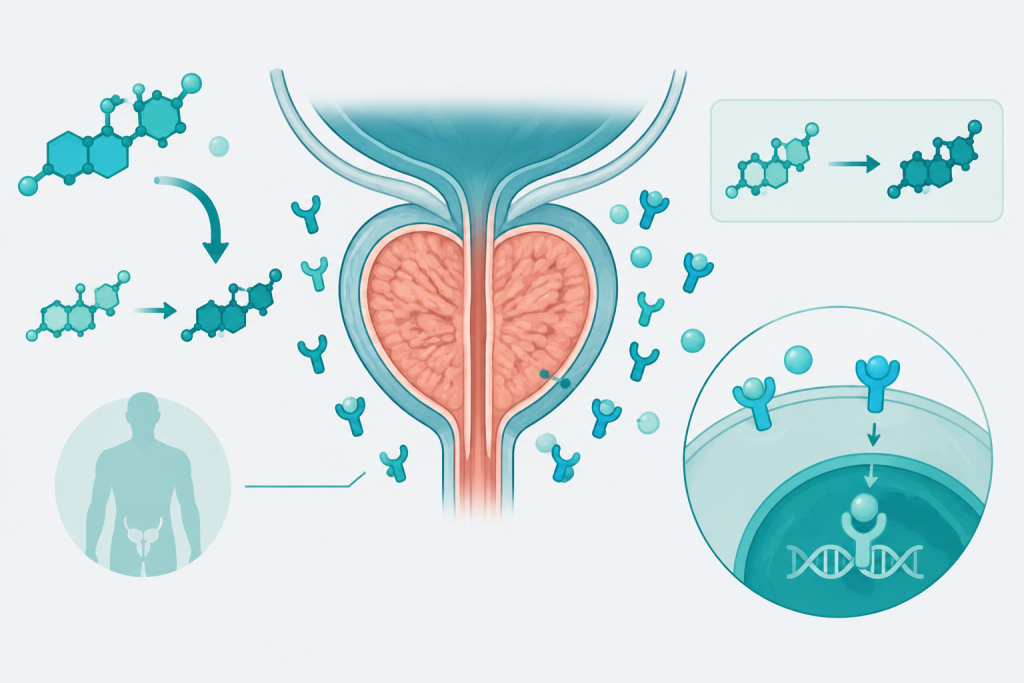
Inside prostate tissue, testosterone diffuses into epithelial and stromal cells. It can bind directly to the androgen receptor, or it can be converted by the enzyme 5-alpha reductase into dihydrotestosterone (DHT). DHT binds the androgen receptor more tightly and remains bound longer, making it an important intraprostatic driver of growth. When anabolic steroids raise circulating testosterone far above the physiological range, the resulting androgen signal may increase, although the effect depends on the compound and its metabolism.
The key distinction is between therapeutic testosterone replacement therapy (TRT) and anabolic steroid abuse. TRT is prescribed for men with clinically low testosterone, uses monitored doses designed to keep levels within a normal range, and includes regular follow-up. Abuse, in contrast, typically involves stacking multiple compounds, doses several times higher than medical recommendations, and no systematic monitoring. The prostate may therefore be exposed to a very different hormonal load in each scenario.
Do Steroids Cause Prostate Enlargement?
Studies on men receiving anabolic steroids have reported measurable increases in prostate volume compared with baseline. The effect is not uniform: it depends on dose, duration, the specific compound, and whether the steroid is aromatised or 5-alpha-reduced. Nevertheless, higher androgen exposure may stimulate prostatic growth, particularly when levels remain above the physiological range.
The mechanism is androgen-driven proliferation. In the prostate, androgen receptors sit in both epithelial and stromal cells. When activated, they promote cell survival, growth-factor signalling, and tissue expansion. DHT, produced locally from testosterone, is a potent ligand. Under supraphysiological androgen loads, this proliferative signal may be stronger and more persistent than the gland normally experiences.
It is worth distinguishing structural enlargement from the urinary symptoms commonly associated with benign prostatic hyperplasia. A man can have a larger prostate on imaging without significant urinary symptoms. Lower urinary tract symptoms—weak stream, hesitancy, nocturia, and incomplete emptying—may occur when enlargement affects the bladder outlet, but symptoms and prostate size do not always correspond closely. Anabolic steroids may increase prostate volume without necessarily producing troublesome urinary symptoms, especially in younger men who start with a small gland.
Whether enlargement fully reverses after cessation is not fully settled. Some evidence suggests prostate volume decreases when androgen exposure returns to baseline, but the extent and speed vary. Age, duration of use, and individual susceptibility may influence the outcome. This uncertainty is one reason why clinicians advise men with known prostate disease to avoid unsupervised androgen use. Even a short cycle may alter baseline measurements and make future screening harder to interpret. Stopping use does not necessarily mean an immediate return to the pre-use state.
Can Testosterone and Anabolic Steroids Lead to Prostate Cancer?
The relationship between androgens and prostate cancer is one of the more debated topics in men’s health. Historically, doctors assumed that higher testosterone necessarily meant higher cancer risk. More recent research has challenged that simple view. In hypogonadal men receiving appropriately monitored testosterone therapy, research has not shown a consistent increase in prostate cancer incidence compared with untreated men.
That said, the absence of evidence for causation is not proof that every situation is risk-free. Prostate cancer in its early stages may be androgen-sensitive. Supplying external androgens to a man who already has an undiagnosed tumour could, in theory, affect its growth. This is why clinical practice generally involves assessing prostate risk and urinary symptoms before starting TRT, with PSA monitoring afterwards.
The difference between causation and progression matters. Causation would mean testosterone creates cancer from healthy tissue. Progression means an existing cancer that depends on androgens may grow faster when androgen exposure increases. Current data are more consistent with concern about progression than with the idea that testosterone initiates prostate cancer. Anabolic steroid abuse, with higher and less predictable hormone levels, adds uncertainty because users rarely undergo the screening that occurs in medical TRT.
One review of anabolic steroid effects and associated health risks is available through PMCID PMC3955334; it discusses how these compounds can affect androgen-responsive tissues. Another older clinical report indexed under PubMed ID 7529633 illustrates the long-standing concern about androgens and prostate pathology. Both support caution around unmonitored androgen exposure.
Is TRT Hard on the Prostate Compared to Steroid Abuse?
The prostate responds to androgen exposure. Physiological testosterone replacement aims to restore a level around the middle of the adult male range. Supraphysiological bodybuilding doses can push total testosterone several times higher. Because local DHT production depends partly on available substrate, the prostate may receive a stronger androgen signal at higher doses.
Under TRT, changes in lower urinary tract symptoms and PSA are often modest, although individual responses vary. Some men notice changes in nocturia or flow; others may report different symptoms for reasons unrelated to the prostate. PSA may drift upwards, which is why clinicians consider changes over time alongside the overall clinical picture rather than relying on a single value.
Monitoring protocols for medically supervised TRT may include a baseline prostate assessment, PSA measurement, haematocrit, and review of urinary symptoms. Some protocols also measure free testosterone and estradiol, depending on the clinical situation. Follow-up testing is arranged during the first year and at regular intervals afterwards. A concerning PSA change, new nodule, or persistent urinary symptoms may prompt referral to a urologist.
Self-administered high-dose steroids carry different risks because few of these safeguards are present. Doses may be guessed, compounds are often stacked, underground products may be mislabelled, and users rarely get PSA checks. A man who would have required further assessment before TRT because of an elevated PSA or suspicious examination can still start a cycle. That difference, rather than the molecule alone, may make unsupervised use harder on the prostate.
| Aspect | Medically supervised TRT | Unsupervised anabolic steroid abuse |
|---|---|---|
| Target testosterone level | Mid-normal physiological range | Supraphysiological, often several-fold above normal |
| DHT exposure | Modest increase from baseline | Often markedly elevated, depending on compound |
| Screening before starting | PSA, DRE, symptom review | Rarely performed |
| Follow-up monitoring | Scheduled labs and exams | Usually absent or sporadic |
| Prostate risk profile | Lower and tracked over time | Higher and largely unknown until symptoms appear |
Can Anabolic Steroids Cause Prostatitis or Other Prostate Problems?
Prostatitis—inflammation or infection of the prostate—is less clearly tied to anabolic steroids than enlargement is. Steroids are not established as a direct cause of bacterial prostatitis. However, changes associated with non-medical steroid use could affect immune function, sexual behaviour, or urinary symptoms in ways that complicate the picture. Anyone using injections also faces the usual risks of poor sterile technique, including abscess or systemic infection.
Urinary symptoms are more commonly reported. Frequency, urgency, weak stream, and the sensation of incomplete emptying can all worsen if the prostate enlarges or if bladder outlet resistance rises. These lower urinary tract symptoms can appear even in the absence of clinically significant prostate enlargement, because smooth-muscle tone in the prostate and bladder neck also influences urinary flow.
Other prostate-related complaints reported in steroid-using populations include elevated PSA, pelvic discomfort, and changes in ejaculate volume or quality. Some men develop pelvic floor tension that resembles prostatitis. Because users may not disclose their regimen to a primary care doctor, these complaints can be difficult to assess until they become persistent or severe.
What About Prednisone and Corticosteroids—Do They Affect the Prostate?
Prednisone and other corticosteroids are often confused with anabolic steroids because both are called “steroids”, but they belong to different classes. Prednisone is a glucocorticoid. It acts on glucocorticoid pathways rather than the androgen receptor, so it does not drive prostate growth in the same way as testosterone derivatives.
Prednisone is therefore not expected to cause prostate enlargement through the androgen mechanism described above. Corticosteroids have their own indications and risks, and their effects should not be assumed to mirror those of anabolic steroids.
Long-term prednisone has its own risks, including bone loss, weight gain, glucose intolerance, and immune suppression, but prostatic enlargement is not usually the main concern. If a man notices urinary symptoms while taking prednisone, the cause should be assessed rather than automatically attributed to the corticosteroid.
Which Steroids Are Considered Safer for Prostate Health?
No anabolic steroid can be called prostate-safe when used at supraphysiological doses. The question is not whether risk exists, but how large it may be under a given set of conditions. Compounds with lower androgenic activity and less interaction with 5-alpha reductase may produce a weaker prostatic signal than testosterone or DHT-derived drugs, but “weaker” is not “zero”.
For example, nandrolone is often discussed as less androgenic in prostate tissue because it is reduced by 5-alpha reductase to a less potent metabolite than DHT. Some non-aromatising, DHT-derived compounds may avoid oestrogenic effects but still bind strongly to androgen receptors in the prostate. Each compound profile involves trade-offs between muscle, side effects, and organ impact.
Even compounds marketed as mild can become problematic when doses escalate. A low-androgenic steroid taken at high doses for long periods may deliver a larger cumulative androgen load than a moderate dose of testosterone monitored under medical care.
Calling a steroid “safer for the prostate” is therefore a relative statement, not an endorsement. It refers to ranking within a risky class, not to safety in absolute terms. Dose, cycle length, stacking pattern, and individual susceptibility may matter more than the compound label.
Individual risk factors also matter. Age, baseline prostate health, pre-existing urinary symptoms, and family history can all influence the overall picture. A young man with a small prostate and no known family history may show fewer measurable changes than an older man with baseline urinary symptoms, but individual responses vary.
Anabolic steroids affect the prostate because the gland responds to androgens. At supraphysiological doses, enlargement, PSA elevation, and urinary symptoms are recognised possibilities. Medically supervised TRT is not the same as abuse: screening, monitoring, and physiological targets change the risk profile substantially. The evidence does not support the old idea that testosterone creates prostate cancer from scratch, but it does support caution about its possible effect on existing disease. If you are already using steroids and noticing urinary changes, the safest course is a medical evaluation rather than adjusting doses on your own. For a full breakdown of anabolic compounds and their effects, see our main reference section.
This article is for informational purposes only and is not a substitute for professional medical advice, diagnosis, or treatment. If you are considering testosterone therapy, anabolic steroids, or any hormone-related intervention, speak with a qualified healthcare provider first. This is especially important if you are over 50, have a family history of prostate disease, or already experience urinary symptoms. The information here describes general research patterns and does not promise any specific outcome for you.