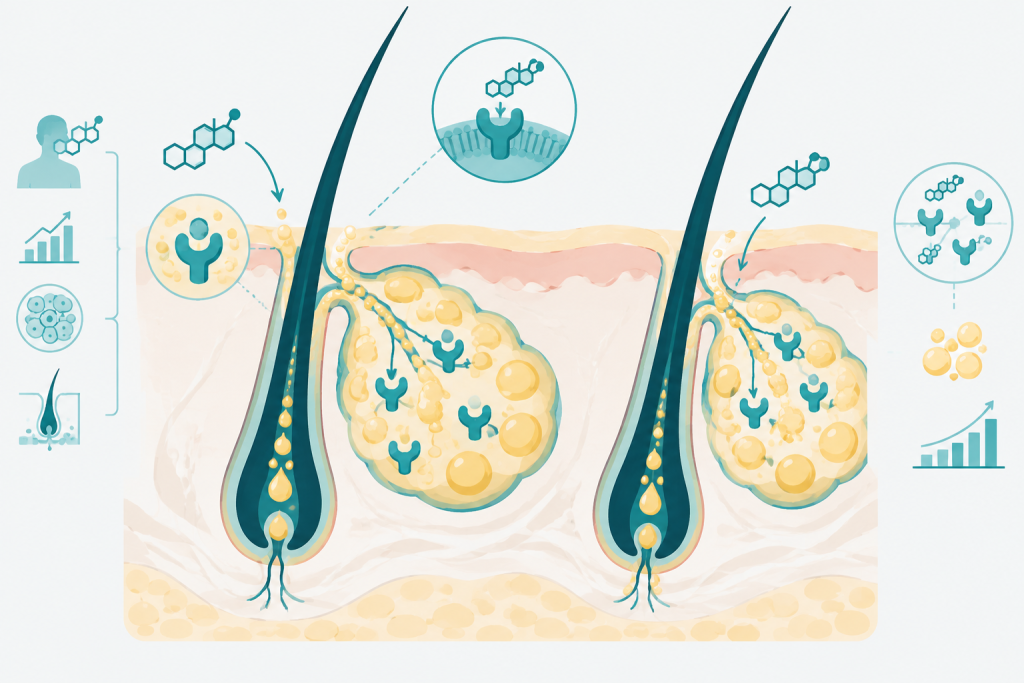
If you have noticed more shine, blackheads, or sudden breakouts after starting an anabolic-androgenic steroid (AAS) cycle, you are not imagining it. AAS are associated with increased sebum production and acneiform eruptions in some users. The effect may reflect the same androgenic activity that influences muscle tissue: when androgen receptors in the skin are activated, sebaceous glands can produce more oil. This can make blocked pores and inflammation more likely. In this article we explain the proposed mechanism, what the lesions may look like, why some bodybuilders are especially prone, how long skin changes may last, and which approaches are described in the medical literature.
- Yes. AAS can increase sebum production and may trigger acne by stimulating androgen receptors in the skin.
- Lesions may appear on the face, chest, back, and shoulders, ranging from mild pimples to severe ulcerated acne such as acne fulminans.
- Improvement may begin after drug levels fall and hormone function changes, but severe or scarring cases need dermatological care.
Why Do Steroids Cause Acne?
How anabolic steroids increase sebum production
Anabolic steroids are androgens, or compounds that act like androgens. The skin—especially on the face, chest, and back—is rich in androgen receptors, many of which sit on or near sebaceous glands. When an AAS binds to these receptors, it can signal the gland to enlarge and produce more sebum. Some testosterone-derived compounds are converted by the 5-alpha-reductase enzyme into dihydrotestosterone (DHT), an androgen that is particularly active in sebaceous tissue. The result may be oilier skin, more clogged follicles, and a greater likelihood of comedones and inflammatory lesions. Sebum is not inherently harmful, but excess sebum and keratin can contribute to follicular blockage and inflammation.
Hormonal shifts that trigger acne formation
AAS use also changes the wider hormonal environment. Exogenous testosterone suppresses the hypothalamic-pituitary-gonadal axis, lowering the body’s own testosterone production. Between injections or doses, blood levels can fluctuate, and some compounds aromatise to estradiol. AAS can also lower sex hormone-binding globulin (SHBG), raising the proportion of free, biologically active androgens. The skin responds to the overall androgen exposure and its variability rather than to a single number on a lab sheet, which may help explain why acne can worsen even when total testosterone appears stable.
Difference between corticosteroid acne and anabolic steroid acne mechanisms
The word “steroid” covers two different drug classes. Corticosteroids such as prednisone are anti-inflammatory and are sometimes used to calm severe skin inflammation. Paradoxically, prolonged or high-dose corticosteroid therapy can itself cause an acneiform eruption, usually through mechanisms that are not primarily androgenic. AAS-related acne, by contrast, is associated with androgen receptor activation and can become severe, including nodulocystic or fulminant disease. A systematic review of anabolic-androgenic steroid-associated acne describes this distinction and notes that severe AAS acne has sometimes been managed with systemic corticosteroids alongside other therapies.
What Does Steroid Acne Look Like?
Visual characteristics of steroid-induced acne
Steroid-induced acne can look different from the gradual breakouts of typical acne vulgaris. It may appear abruptly, sometimes within weeks of starting or increasing a dose. The lesions are often monomorphic—many small papules and pustules of similar size and stage—rather than the mixed blackheads, whiteheads, and cysts seen in ordinary teenage acne. The skin may feel greasy, and the lesions can be tender or itchy. When lesions appear in crops, the breakout may look more uniform across an area.
Common locations: face, chest, back
The same areas that are naturally oilier are often affected most. The face, especially the forehead, nose, and chin, may show increased shine and small inflammatory lesions. The chest, upper back, and shoulders are also common sites because they have a high density of sebaceous follicles. In severe cases, lesions may extend to the upper arms and buttocks. Workout clothing can trap heat and sweat in these areas, adding mechanical irritation to the hormonal trigger.
Steroid acne vs normal acne: key differences
| Feature | Typical acne vulgaris | Steroid-induced acne |
|---|---|---|
| Onset | Gradual, often linked to puberty, stress, or menstrual cycles | Sudden, often after starting or increasing AAS |
| Lesion types | Mixed: blackheads, whiteheads, papules, pustules, cysts | Mostly monomorphic papules and pustules |
| Common locations | Face, jawline, sometimes chest or back | Face, chest, back, shoulders, upper arms |
| Main driver | Genetics, hormones, bacteria, skin care factors | High androgen receptor stimulation |
| Severity range | Mild to severe | Mild oiliness to severe ulcerated acne fulminans |
Severity spectrum from mild to severe ulcerated bodybuilding acne
At the mild end, a user may simply notice more blackheads and a shiny complexion. At the moderate end, inflammatory papules and pustules may cover the trunk and cause significant distress. The severe end includes nodulocystic acne and acne fulminans, a rare form marked by sudden ulcerated lesions, fever, joint pain, and elevated inflammatory markers. This requires urgent medical assessment and may require hospital-level care.
Why Do Bodybuilders Get So Much Acne?
Connection between AAS injection use and acneiform lesions
Bodybuilders appear in case reports of severe steroid acne because some regimens involve androgen exposure well above physiological levels. The risk is not limited to skin contact at injection sites; once an AAS enters the bloodstream, it can affect androgen receptors throughout the body, including the skin. Some users develop a widespread acneiform eruption even though the injections were given in the thigh or shoulder.
Dosage and cycle patterns that increase acne risk
Higher doses, longer cycles, and rapid dose changes may increase the likelihood of breakouts. The skin responds to overall androgen exposure over time, and fluctuating blood levels may contribute to increased sebaceous activity. Short, aggressive “blast” phases are sometimes reported alongside more severe skin flares than longer, lower-dose protocols, although individual responses vary.
Role of multiple compounds in compounding effects
Stacking testosterone with more androgenic agents may increase the overall androgenic load on the skin. Some compounds are metabolised into DHT or similar androgens, while others may indirectly affect oestrogen or SHBG levels. The combined effect may produce a stronger signal at the sebaceous gland. For readers who want to understand how individual agents differ, see our detailed breakdown of specific compounds and their androgenic effects.
How Long Does Steroid Acne Take to Clear?
Timeline after stopping anabolic steroids
Once AAS use stops, the skin may take time to settle. Oiliness can begin to decrease over the following weeks, while active lesions may take longer to improve. The timeline depends on how long the compounds were used, their half-lives, individual clearance rates, baseline sebaceous gland activity, and whether post-cycle therapy is being used. Short cycles of single compounds may clear faster than long, multi-drug stacks, but there is no single timeline that applies to everyone.
Factors affecting clearance rate
Several variables influence how quickly the skin calms down. Long-acting esters remain in the body for weeks, so androgen receptor stimulation can persist after the last injection. Genetic differences in 5-alpha-reductase activity mean some people convert more testosterone to DHT. Pre-existing acne, oily skin, and follicular microbes can also keep lesions active after serum androgen levels fall. Sebaceous glands that have enlarged under AAS stimulation may also take time to return towards their previous size.
What happens with prednisone acne after stopping
Prednisone and similar corticosteroids can themselves trigger an acneiform eruption, but the mechanism is different from that of AAS acne. After tapering and discontinuing the corticosteroid, the eruption may improve over the following weeks. Because prednisone is sometimes prescribed to control inflammation in severe AAS acne, the course should be managed by a clinician rather than stopped abruptly.
Managing Steroid-Induced Acne
Medical treatment approaches documented in cases
Case reports and clinical reviews describe a stepwise approach. Mild cases may be managed with topical agents that reduce blocked pores and surface bacteria, such as adapalene or benzoyl peroxide. Inflammatory acne is sometimes addressed with oral antibiotics under medical supervision. Severe or scarring acne, including acne fulminans, has been reported in cases managed with oral isotretinoin; fulminant cases may first require systemic corticosteroids to bring inflammation under control before isotretinoin is introduced. Anti-androgen or hormonal modifiers are occasionally discussed in dermatology for androgen-driven acne, but they require specialist oversight and are not appropriate for everyone.
Measures for blocked pores and oil control
For blocked pores and oil control at home, gentle twice-daily cleansing, non-comedogenic moisturisers, and avoiding heavy occlusive products may help limit factors associated with breakouts. Salicylic acid may reduce pore blockage for some people, and benzoyl peroxide can reduce C. acnes counts. However, home measures cannot remove the androgen exposure associated with AAS. Picking or scrubbing aggressively can worsen inflammation and increase the risk of scarring.
When to seek dermatological care for severe cases
You should see a dermatologist if lesions are painful, deep, or scarring, if there is a sudden widespread eruption, or if over-the-counter measures do not produce improvement after several weeks. Early professional input may help limit the risk of permanent scarring from severe nodulocystic acne. A clinician can also rule out other conditions that look similar, such as folliculitis or a drug eruption from another medication.
Limitations of home remedies for steroid acne
Home remedies may help with surface oil and mild comedones, but they do not address the hormonal driver. Diet changes, supplements, and aggressive detox routines have limited evidence for reversing AAS-induced sebum overproduction. If the underlying androgen exposure remains high, breakouts may continue despite changes to a skincare routine.
Will Acne From Steroids Go Away on Its Own?
Natural resolution timeline and what to expect
In many cases, acne improves after exogenous androgen exposure falls, although the timing varies. As the hypothalamic-pituitary-gonadal axis recovers, sebum production may also fall and breakouts may subside. This process can take weeks to a few months, and some people recover more slowly after long or high-dose cycles. Gentle, consistent skincare is generally preferable to adding harsh products.
Difference between TRT-related acne and high-dose AAS acne
Acne during medically supervised testosterone replacement therapy may be milder when doses are intended to remain within physiological levels and are relatively steady. High-dose, multi-compound AAS cycles can produce larger hormonal fluctuations and higher androgen exposure, so acne may be more severe or slower to resolve. Individual sensitivity varies even within TRT, and a clinician may consider dose adjustments or formulation changes where appropriate.
Persistent cases that require intervention
If acne continues for several months after stopping AAS, leaves scars, or causes significant distress, a dermatologist should evaluate it. Possible contributing factors include ongoing hormonal changes, DHT sensitivity, or follicular inflammation. Prompt assessment can help reduce the risk of lasting scarring.
This article is for informational purposes only and is not a substitute for professional medical advice, diagnosis, or treatment. Talk to a qualified healthcare provider before making any changes to medications, supplements, or skincare routines, especially if you are pregnant, taking prescription medicines, or have a chronic health condition. Individual results vary, and nothing here guarantees a specific outcome.