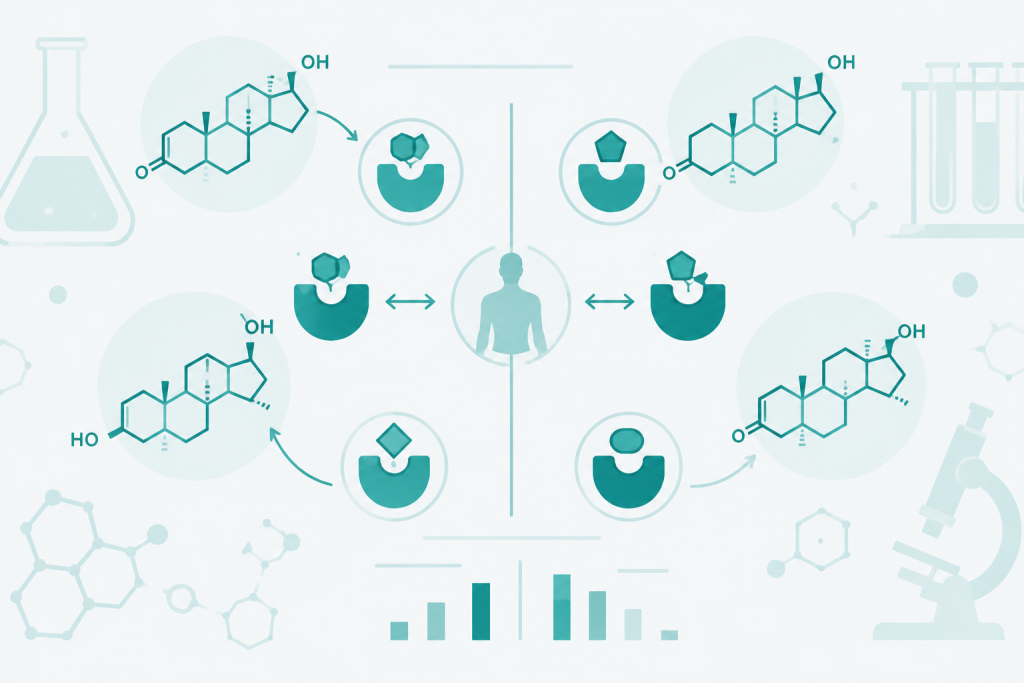
People often use the words “testosterone” and “anabolic steroids” as if they are separate categories, but the relationship is more like a square and a rectangle: testosterone is itself an anabolic-androgenic steroid, while most compounds sold as “anabolic steroids” are synthetic derivatives of it. Understanding the difference matters whether you are trying to make sense of blood work, compare prescription therapy with athletic use, or simply sort out the terminology.
- Testosterone is the body’s principal naturally produced androgen and an anabolic-androgenic steroid; synthetic anabolic steroids are modified versions of testosterone or related compounds.
- TRT aims to restore normal testosterone levels under medical supervision; non-medical anabolic steroid use usually pushes levels far above the natural range.
- Blood tests measure total and free testosterone, and regular monitoring is essential for anyone using external androgens.
- Supraphysiological doses carry a broader set of cardiovascular, liver, endocrine, and psychiatric risks than physiological replacement.
What Is Testosterone? Natural Production and Function
Testosterone is a steroid hormone best known as the main androgen in men, though it is also present in women in smaller amounts. In men, the vast majority is produced in the testes by specialised cells called Leydig cells. Production is regulated by the hypothalamic-pituitary-gonadal (HPG) axis. The hypothalamus releases gonadotrophin-releasing hormone (GnRH), which signals the anterior pituitary to secrete luteinising hormone (LH) and follicle-stimulating hormone (FSH). LH travels to the testes and stimulates Leydig cells to synthesise testosterone. When blood testosterone rises, negative feedback tells the hypothalamus and pituitary to throttle back GnRH and LH, keeping levels within a homeostatic range.
Testosterone’s effects begin before puberty. During fetal development, it contributes to the development of male internal reproductive structures, while its metabolite dihydrotestosterone has a major role in the development of the external genitalia. At puberty, a surge in testosterone triggers the development of male secondary sexual characteristics: deepening of the voice, growth of facial and body hair, increased muscle and bone mass, shoulder widening, and growth of the penis and testes. In adult men, testosterone continues to support libido, erectile function, and sperm production, the latter requiring the combined action of FSH on the Sertoli cells.
Clinically, adult male total testosterone is often reported within a reference range of roughly 300 to 1,000 ng/dL, though exact numbers vary by laboratory, assay method, and population. Testosterone follows a circadian rhythm, with the highest values in the early morning and a gradual decline through the day. Age, body fat percentage, sleep quality, alcohol intake, chronic illness, and certain medications can all move the needle. Because of this variability, a single abnormal value is usually confirmed with repeat morning testing and correlated with symptoms.
Beyond reproduction and sexual function, testosterone influences tissues throughout the body. It promotes muscle protein synthesis and helps maintain lean body mass, supports bone mineral density and bone turnover, and stimulates erythropoiesis—the production of red blood cells. It also affects mood, motivation, cognitive performance, fat distribution, and skin oil production. These wide-ranging effects explain why testosterone levels are relevant to athletes, clinicians, and anyone tracking long-term health.
What Are Anabolic Steroids and How Do They Differ from Natural Testosterone?
Anabolic steroids, more precisely called anabolic-androgenic steroids (AAS), are testosterone and its synthetic derivatives. Testosterone is the reference compound against which other AAS are compared. When someone refers to “anabolic steroids” in a sports or bodybuilding context, they usually mean synthetic molecules such as nandrolone, oxandrolone, stanozolol, boldenone, or trenbolone rather than testosterone itself.
All AAS share the same four-ring steroid nucleus. What sets them apart are chemical modifications. Changes at the 17-alpha position can make an oral compound survive its first pass through the liver, while esterification at the 17-beta position turns testosterone into injectable depot forms such as testosterone enanthate, cypionate, or undecanoate. Other alterations to the A-ring or side chains can reduce conversion to oestrogen, limit 5-alpha-reductase activity, or shift the balance between tissue-building and masculinising effects. These modifications determine how a compound is absorbed, how long it acts, how it is metabolised, and what side effects are most likely.
The two categories of effects are described as anabolic and androgenic. Anabolic effects build tissue: increased protein synthesis, nitrogen retention, muscle fibre growth, bone density, and red blood cell production. Androgenic effects relate to male sexual characteristics: voice deepening, facial and body hair growth, prostate effects, sebaceous gland activity, and male-pattern baldness. Testosterone is assigned an anabolic-androgenic ratio of 1:1 by definition. Other steroids are often described as more anabolic or more androgenic relative to testosterone, but these ratios come from older animal studies and do not map cleanly onto human responses.
Medical Testosterone (TRT) vs Anabolic Steroids: Key Differences in Use
Testosterone replacement therapy, or TRT, is the medical use of prescription testosterone in men diagnosed with hypogonadism. Diagnosis usually requires consistently low morning testosterone together with symptoms such as low libido, fatigue, depressed mood, or reduced physical performance. The goal of TRT is not enhancement but restoration: bringing testosterone back into the normal adult range and keeping it there.
Medical testosterone is available in several forms. Injectable testosterone esters are absorbed over days or weeks and are usually given in muscle or subcutaneous tissue. Transdermal gels and patches deliver a steady daily dose through the skin. Less commonly, clinicians use buccal tablets, nasal gel, or implanted subcutaneous pellets. The choice depends on patient preference, cost, convenience, pharmacokinetics, and how well a man maintains stable levels on a given preparation.
Non-medical anabolic steroid use is different in intent, dose, and context. It typically involves taking one or more synthetic AAS at doses that produce blood levels well above the natural range, often in cycles, stacks, or pyramids, with the aim of increasing muscle size, strength, leanness, or recovery. These protocols are not standardised medical treatments and are generally not supervised by clinicians in the same way as TRT.
Dosing is the clearest practical distinction. TRT aims to keep total testosterone within, or close to, the normal reference range. Non-medical AAS use, by contrast, often employs total weekly doses that are many times higher than the body produces naturally, sometimes combining multiple compounds. This supraphysiological exposure is what changes both the magnitude of the effects and the spectrum of possible adverse outcomes.
Legally and medically, the boundary is important. In many countries, testosterone is a controlled substance available only by prescription, and possession or use without a prescription can carry legal penalties. Most synthetic AAS are similarly controlled. In competitive sport, testosterone and other AAS are prohibited by the World Anti-Doping Agency and most national federations when used outside the applicable rules; testosterone is permitted only under a formal Therapeutic Use Exemption when clinically justified.
| Aspect | Testosterone Replacement Therapy (TRT) | Non-medical Anabolic Steroid Use |
|---|---|---|
| Primary goal | Restore testosterone to the normal adult range | Increase muscle, strength, or leanness beyond natural limits |
| Who oversees it | Licensed clinician | Usually self-directed |
| Target blood levels | Within or near the reference range | Often far above the natural range |
| Common preparations | Injections, gels, patches, pellets | Injections, oral tablets, sometimes blends |
| Monitoring | Scheduled labs and clinical follow-up | Often inconsistent or absent |
| Legal status | Prescription-only controlled substance | Illegal without prescription in many jurisdictions |
| Typical risk profile | Erythrocytosis, acne, fertility changes, fluid retention | Cardiovascular, liver, endocrine, psychiatric, and injection-related risks |
Testosterone Testing: When and How Levels Are Measured
Blood testing is the standard way to evaluate testosterone status. The most common test measures total testosterone, which includes testosterone bound to sex hormone-binding globulin (SHBG) and albumin plus the small unbound, or free, fraction. Because most circulating testosterone is bound, total testosterone can be misleading when SHBG is unusually high or low. Free testosterone—the fraction available to enter cells—can be measured directly or calculated from total testosterone, SHBG, and albumin.
Testing is usually recommended when a man has symptoms consistent with low testosterone, such as reduced libido, erectile difficulties, low energy, depressed mood, loss of muscle mass, increased body fat, or poor sleep. It is also used during fertility evaluation, before starting TRT, to monitor response to therapy, and in athletic or forensic settings to detect exogenous androgen use.
For reliable interpretation, testosterone should be measured in the early morning, when levels peak, and repeated on a different day if the first result is unexpected or borderline. Clinicians also look at related markers: LH and FSH to distinguish primary from secondary hypogonadism, prolactin if the pituitary is suspected, thyroid function, oestradiol, SHBG, albumin, haematocrit, and lipid panels. A single low number without symptoms is not enough to diagnose hypogonadism.
Monitoring frequency depends on the setting. For TRT, clinicians typically recheck testosterone, haematocrit, and other safety labs three to six months after starting or changing a dose, then every six to twelve months. Men using non-medical AAS may undergo testing for testosterone, LH, FSH, oestradiol, lipids, liver enzymes, haematocrit, and blood pressure, though the schedule depends on the compounds used and whether a clinician is involved. Our compound-specific monitoring protocols and reference ranges outline the main markers for each common approach.
Safety and Side Effects: Comparing Natural Testosterone, TRT, and Anabolic Steroids
Using anabolic steroids at doses above the natural range, especially without medical supervision, is associated with documented risks to the heart, liver, hormones, and mental health. This is not the same as physiological testosterone replacement.
Natural testosterone, maintained by the body’s own feedback loops, is self-limiting: when levels rise, the brain reduces stimulation. External androgens bypass some of these controls, and the risk profile changes with dose, compound choice, route of administration, and monitoring.
Supraphysiological anabolic steroid use carries the broadest set of risks. Cardiovascular effects can include unfavourable shifts in cholesterol, elevated blood pressure, left ventricular hypertrophy, and increased clotting tendency. Oral 17α-alkylated steroids are particularly associated with liver stress, cholestasis, peliosis hepatis, and liver tumours. Endocrine effects include HPG-axis suppression, testicular shrinkage, reduced or absent sperm production, gynaecomastia from aromatisation to oestradiol, acne, and acceleration of male-pattern hair loss. Psychological effects may include irritability, mood swings, aggression, impulsivity, and, in some users, dependence. Injection-related complications such as infections, abscesses, and scar tissue are also reported.
TRT, when prescribed and monitored, has a narrower and more predictable risk profile. The most common issues are erythrocytosis (rising haematocrit), acne or oily skin, fluid retention, reduced fertility, and possible worsening of sleep apnoea. Prostate health is monitored because testosterone can influence prostate tissue, although the relationship between TRT and prostate cancer progression remains individualised and is still studied. The central difference is that TRT targets physiological levels and includes scheduled follow-up, allowing clinicians to catch changes before they become serious.
Both TRT and non-medical AAS suppress the body’s own testosterone production. Exogenous androgens signal the hypothalamus and pituitary to reduce GnRH, LH, and FSH output. Without LH, Leydig cells produce little testosterone and the testes may atrophy. Without FSH, sperm production falls. Recovery after discontinuation can take months, and some men—particularly after long or high-dose use—do not return fully to baseline. This is why men who want to preserve fertility are often counselled before starting TRT or any AAS cycle.
Behavioural effects also track with dose. Near-physiological TRT is not typically linked to dramatic mood changes, though individual responses vary. At supraphysiological doses, some users report increased confidence, irritability, or aggression; others experience anxiety or insomnia. Stopping abruptly can produce a “crash” of low mood, fatigue, and loss of libido until the HPG axis recovers.
Long-term, the natural decline of testosterone with age is gradual and differs widely between men. Chronic high-dose AAS use has been associated in observational research with higher rates of cardiovascular and metabolic problems, though users often have other lifestyle risk factors. TRT studies over several years have shown benefits for some symptoms and bone health but have produced mixed findings on cardiovascular outcomes. For both medical and non-medical use, ongoing monitoring and an honest relationship with a clinician are the most practical safeguards.
Sources
This article is for informational purposes only and is not a substitute for professional medical advice, diagnosis, or treatment. If you are considering testosterone therapy, anabolic steroids, or any hormone-related intervention, speak with a qualified healthcare provider first. This is especially important if you are pregnant, taking prescription medications, or have a chronic medical condition. Individual responses vary, and this article does not promise a specific outcome.