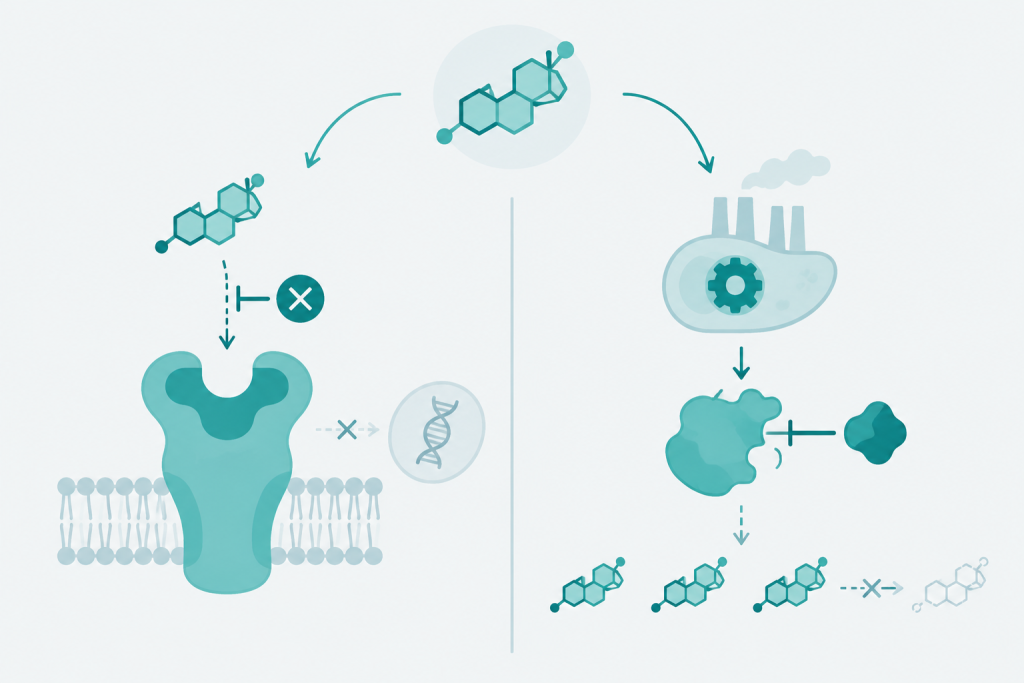
If you’ve spent any time reading about hormone management — whether for medical reasons, fertility, or post-cycle recovery — you’ve probably come across two acronyms: SERMs and AIs. They’re often mentioned in the same breath, sometimes treated as interchangeable. They’re not. This guide explains how the two drug classes differ, why that distinction matters, and the contexts in which each may be used.
- SERMs (such as tamoxifen and clomiphene) act on oestrogen receptors in selected tissues; they do not directly lower circulating oestrogen.
- Aromatase inhibitors (such as anastrozole and letrozole) inhibit the enzyme that produces oestrogen from androgens, lowering circulating oestrogen.
- In sports pharmacology, SERMs are often used in post-cycle protocols and AIs to manage oestrogen levels, but neither use is a universal or medically established protocol for anabolic-steroid use.
- Neither class is an anabolic steroid, but both affect hormonal pathways and have significant risks.
What are SERMs and aromatase inhibitors, and how do they work differently?
The core difference is where each drug acts in the oestrogen pathway. Oestrogen acts by binding to receptors in tissues such as breast tissue, bone, the brain and the liver. SERMs and AIs affect this pathway at different points.
SERMs (selective oestrogen receptor modulators) bind to oestrogen receptors and can block or activate them depending on the tissue and the drug. They do not directly reduce the amount of oestrogen circulating in the body. The “selective” part matters: a SERM may block oestrogen’s effects in one tissue while partly mimicking them in another. The precise effects differ between drugs.
Aromatase inhibitors work one step earlier. The body produces oestrogen by converting androgens — including testosterone and androstenedione — via an enzyme called aromatase. An AI inhibits that enzyme, reducing this conversion and lowering circulating oestrogen. The effect is systemic rather than limited to a particular tissue.
The fundamental distinction is receptor modulation versus reduced production. A SERM does not lower oestrogen itself; an AI reduces the amount produced through aromatase. Neither description means that either class is suitable for every cause of an oestrogen-related symptom.
Oestrogen has important roles in bone density, sexual function, mood and lipid metabolism. Suppressing it too far can cause problems, including joint symptoms, low libido, mood changes and adverse effects on bone and lipids. The right approach depends on the indication, the individual and laboratory results.
Which specific drugs fall into each category?
Here are some medicines you’ll encounter in each class. The doses below are labelled medical regimens or examples reported in non-medical use; they are not interchangeable recommendations. Indication, formulation and clinical guidance matter.
| Class | Drug (brand name) | Type | Common dosing context |
|---|---|---|---|
| SERM | Tamoxifen (Nolvadex) | Non-steroidal, triphenylethylene | 20 mg/day is a common medical dose for some indications; dosing is indication-specific. Non-medical PCT regimens vary. |
| SERM | Clomiphene (Clomid) | Non-steroidal, triphenylethylene | Medical dosing varies by indication; male use is generally off-label. Non-medical PCT regimens vary. |
| SERM | Raloxifene (Evista) | Non-steroidal, benzothiophene | 60 mg/day for approved indications; use for gynaecomastia is off-label. |
| AI | Anastrozole (Arimidex) | Non-steroidal, reversible | 1 mg/day for some medical indications; non-medical use is not a standard regimen. |
| AI | Letrozole (Femara) | Non-steroidal, reversible | 2.5 mg/day for some medical indications; non-medical use is not a standard regimen. |
| AI | Exemestane (Aromasin) | Steroidal, irreversible | 25 mg/day for some medical indications; non-medical use is not a standard regimen. |
Within the AI class there’s another distinction: steroidal versus non-steroidal. Anastrozole and letrozole are non-steroidal inhibitors that bind aromatase reversibly. Exemestane is steroidal: its structure resembles androstenedione, and it inactivates aromatase irreversibly. The body must produce new enzyme to restore aromatase activity, so recovery does not happen as soon as the drug leaves the bloodstream.
One clarification: aromatase inhibitors are not anabolic steroids — not even the “steroidal” one. Exemestane has a steroid-like molecular structure, but it does not have the anabolic or androgenic effects of anabolic steroids. The label describes its chemistry, not its effect. For the broader picture, see our detailed breakdown of how steroids affect hormone balance.
When is each type used, and can men take them?
In mainstream medicine, both classes have roles in hormone-receptor-positive breast cancer treatment. The choice depends on factors including menopausal status and the treatment plan. In premenopausal women, ovarian oestrogen production continues, so an AI is generally used only with ovarian suppression. In postmenopausal women, aromatase is a major source of oestrogen, making AIs an option. Trials including ATAC, which compared anastrozole with tamoxifen in postmenopausal women, informed treatment practice (PubMed).
Men may be prescribed either class for specific indications, although some uses are off-label:
- Fertility and testosterone. Clomiphene is sometimes used off-label in men with low testosterone who wish to preserve fertility. By modulating oestrogen feedback at the hypothalamus and pituitary, it can increase LH and FSH, which signal the testes. Whether it is appropriate depends on the cause of low testosterone and fertility goals.
- Gynaecomastia. Tamoxifen is sometimes prescribed for painful or recent-onset gynaecomastia; raloxifene has also been used off-label. Persistent or unexplained breast enlargement needs assessment to establish the cause.
- Oestrogen management during testosterone therapy. Anastrozole is sometimes prescribed when clinically significant symptoms and test results support treatment. A raised estradiol result alone does not automatically mean an AI is needed.
In sports pharmacology, AIs are used by some people taking aromatisable anabolic steroids to lower oestrogen, while SERMs are used in some post-cycle protocols. These are non-medical practices, not established treatment protocols. There is no single reliable dose or schedule: the drugs, ester, cycle, symptoms and laboratory results all affect the situation. A post-cycle SERM regimen cannot be assumed to restore natural testosterone production, and starting treatment 2–3 weeks after an injection is not suitable for every compound or person. For an overview of related issues, see our review of oestrogen-related side effects associated with anabolic steroids.
The practical distinction is whether the goal is to alter receptor activity in a particular tissue or to lower oestrogen production overall. The cause of the problem and appropriate tests need to be established before choosing a drug.
How do the side effect profiles compare?
Both classes can cause significant adverse effects, but their risks differ.
| Concern | SERMs | Aromatase Inhibitors |
|---|---|---|
| Hot flashes | Can occur | Can occur |
| Blood clots (VTE) | Risk is increased with tamoxifen | Not a typical class effect |
| Bone density | Effects vary by drug and tissue; raloxifene is approved for osteoporosis | Long-term use can accelerate bone loss |
| Joint pain / stiffness | Uncommon | Common |
| Cholesterol | Tamoxifen may affect lipid levels | May adversely affect lipid levels |
| Low-oestrogen symptoms (low libido, low mood, joint discomfort) | Not typical of receptor blockade alone | Possible if oestrogen is suppressed too far |
| Visual disturbances | Reported with clomiphene; urgent assessment is appropriate | Not typical |
The SERM signature risks include blood clots, particularly with tamoxifen. Anyone with a personal history of thrombosis should discuss this risk with their prescriber. Clomiphene can cause visual disturbances; stop taking it and seek prompt medical advice if these occur. SERM effects on bone vary by drug and tissue.
The AI risks are associated in part with reducing oestrogen too far or for too long. Joint pain and stiffness are common complaints. Long-term suppression can reduce bone density, and AIs may adversely affect cholesterol. Monitoring depends on the indication and duration.
Tolerability depends on the drug, dose and duration. With SERMs, clot symptoms and visual changes deserve attention; with AIs, clinicians may monitor estradiol, lipids and, for longer-term treatment, bone health. For an overview of hormonal feedback loops, see this open-access review on PMC.
Which is more effective for controlling oestrogen-related effects?
“More effective” depends on the goal. The ATAC trial compared anastrozole with tamoxifen in postmenopausal women with breast cancer and found better recurrence-free outcomes with anastrozole over follow-up (PubMed). Those results apply to that clinical setting, not automatically to men using anabolic steroids or to post-cycle recovery. In premenopausal women, an AI alone is generally inadequate because the ovaries continue to produce oestrogen.
The broader principle is that the drugs act at different points: SERMs modulate receptor activity, while AIs reduce oestrogen production via aromatase.
- If the concern involves a specific tissue, such as breast tissue in gynaecomastia, a SERM may be considered for particular clinical situations. Diagnosis and timing matter.
- If tests and clinical assessment indicate excess oestrogen production, an AI may be considered. A SERM does not lower circulating oestrogen.
- For recovery of natural testosterone production, neither drug class is a guaranteed solution. The cause of suppression, the drugs used and the time since stopping them all matter; assessment should include appropriate hormone testing.
In short, anastrozole can lower oestrogen production in a way tamoxifen cannot, while tamoxifen modulates breast-tissue receptors in a way an AI does not. Neither is simply “stronger” in every context.
Can you use SERMs and aromatase inhibitors together, or must you choose one?
They can be prescribed together in some circumstances, but combining them is not automatically more effective. In breast cancer research, the ATAC trial included an anastrozole-plus-tamoxifen arm; the combination did not improve outcomes over tamoxifen alone (PubMed). That result does not establish a safe or useful combination for other settings.
Some people combine an AI with a SERM in sports-pharmacology settings, but this should not be treated as a standard way to prevent gynaecomastia. Each drug adds risks, and the combination can make symptoms and test results harder to interpret. A clinician should assess new breast symptoms rather than relying on a self-directed drug combination.
Sequential use is common in some medical treatment plans. In non-medical steroid use, people may use an AI during a cycle and a SERM afterwards, but that sequence is not a validated protocol and does not ensure hormonal recovery. The timing and need for treatment cannot be determined from the calendar alone.
A practical framework:
- One suspected problem? Confirm its cause before choosing a medicine. A raised laboratory value alone does not establish that treatment is needed.
- More than one concern? Do not assume that combining drugs is safer or more effective. The risks and interactions need individual assessment.
- Changing treatment phases? Do not continue or switch medicines indefinitely without reviewing symptoms and appropriate laboratory results.
Monitoring depends on the drug and reason for use. It may include estradiol, testosterone, LH, FSH and lipids; liver tests or bone-health assessment may be appropriate in some settings. For background on hormonal feedback loops, see our article on understanding the broader steroid-hormone relationship.
- SERMs modulate oestrogen receptors in selected tissues; AIs reduce oestrogen production via aromatase.
- Both classes have medical uses, but non-medical use for cycle management or PCT is not a standardised treatment protocol.
- SERM risks include blood clots and, with clomiphene, possible visual effects; AI risks include joint symptoms, lipid changes and bone loss.
- Choose treatment only after considering the indication, symptoms and test results; combining drugs is not automatically beneficial.
This article is for informational purposes only and is not medical advice. SERMs and aromatase inhibitors are prescription medicines with real risks, and individual responses vary. Discuss their use with a qualified clinician, especially if you take other medicines or have a history of blood clots, cardiovascular problems or chronic illness.