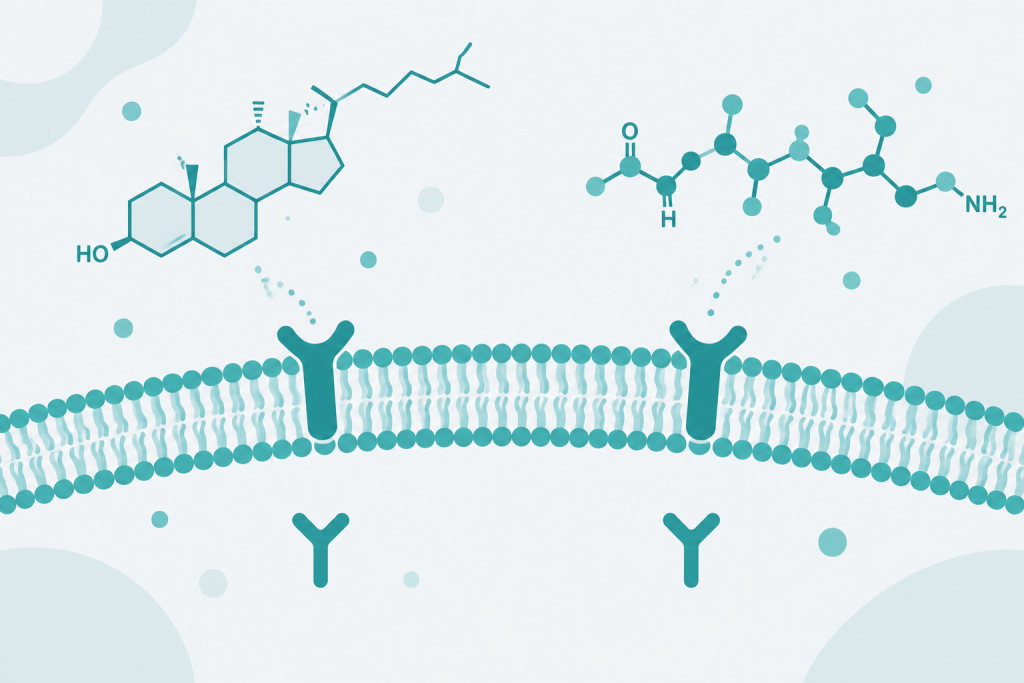
“Steroid” and “hormone” are two technical-sounding words that often get thrown around as if they mean the same thing, or as if they are opposites. You might read that someone’s “hormones are out of balance,” then hear that another person is “taking steroids.” The confusion is understandable, because the two categories overlap. In plain language, a hormone is a messenger molecule, while a steroid is one of several chemical families that hormones can belong to. All steroid hormones are hormones, but many hormones are not steroids. Understanding that distinction makes it easier to interpret blood tests, compare substances, and understand how external steroids can alter the body’s own chemistry.
- All steroid hormones are hormones, but “hormone” is a much broader category.
- Steroid hormones are built from cholesterol; peptide hormones are built from amino acids.
- They reach cells differently, which changes how fast and how long their effects last.
- External steroids can suppress the body’s natural hormone production through feedback loops.
Are steroids hormones?
The short answer is yes, but only some hormones are steroids. In biology, a hormone is any signalling molecule that is released into the bloodstream or local tissue and tells target cells to change their activity. That definition is about function, not chemistry. Hormones can be proteins, peptides, modified amino acids, fatty-acid derivatives, or cholesterol derivatives.
A steroid hormone is simply a hormone whose molecule is built around a characteristic four-ring carbon skeleton derived from cholesterol. The body makes steroid hormones in the adrenal cortex, testes, ovaries, and placenta using enzymes that strip, add, or rearrange side chains on a cholesterol backbone. Because the finished molecule is fat-soluble, it can dissolve into the lipid bilayer of cell membranes rather than staying in the watery bloodstream like a protein.
So when people ask “are steroids hormones?” they are usually mixing up two levels of classification. “Steroid” tells you what the molecule looks like and where it came from. “Hormone” tells you what it does. Testosterone is both a steroid molecule and a hormone messenger. Insulin is a hormone messenger, but it is a peptide, not a steroid.
Watch the everyday meaning of “steroids.” In sports and gym culture, “steroids” almost always means synthetic anabolic-androgenic steroids. These are laboratory-made molecules based on testosterone, a natural steroid hormone. They are not identical to what the body produces, and they are designed to emphasise certain effects. That matters because their impact on natural hormone regulation can be strong.
Which hormones are steroids?
The steroid hormones most people encounter, whether in a biology class or a blood panel, include:
- Testosterone — the main androgen in men, produced primarily in the Leydig cells of the testes; women produce smaller amounts in the ovaries and adrenal glands.
- Estradiol — the dominant estrogen in premenopausal women, produced mainly in the ovaries; men convert a small fraction of testosterone into estradiol through the aromatase enzyme.
- Progesterone — produced by the corpus luteum and placenta, essential for the menstrual cycle and pregnancy.
- Cortisol — released by the adrenal cortex, involved in metabolism, immune response, and the stress response.
- Aldosterone — also from the adrenal cortex, controls sodium and potassium balance and helps regulate blood pressure.
Two questions come up constantly: “Is testosterone a steroid or a hormone?” and “Is estrogen a hormone or a steroid?” The answer to both is “both.” They are steroid hormones. The same is true for cortisol and aldosterone. If a substance is a hormone and its structure is built from cholesterol, calling it a steroid hormone is the most accurate label.
All of these molecules share the same cholesterol-derived skeleton. If you overlaid their structures, you would see the same four fused rings. The differences are in the oxygen atoms, double bonds, and side chains attached to those rings. That shared architecture is why steroid hormones are grouped together chemically, even though their effects and receptor interactions are very different.
Which hormones are not steroids?
The majority of hormones are not steroids. The largest group is the peptide and protein hormones, which are chains of amino acids. Examples include insulin, growth hormone, prolactin, oxytocin, vasopressin, and the pituitary tropic hormones such as thyroid-stimulating hormone, luteinising hormone, and follicle-stimulating hormone. Some peptide hormones are only a few amino acids long; others, like growth hormone, are large proteins.
Peptide hormones are synthesised differently from steroid hormones. The cell creates a longer precursor protein, often a preprohormone, and then cuts it into the active molecule with enzymes. Because they are water-soluble and relatively large, they cannot slip through the fatty cell membrane. They must bind to receptors on the outside of the target cell and trigger internal signalling cascades.
Amine hormones form another non-steroid class. Thyroid hormone and the catecholamines adrenaline, noradrenaline, and dopamine are derived from the amino acid tyrosine. Is thyroid hormone a steroid? No. Thyroxine (T4) and triiodothyronine (T3) contain iodine and tyrosine but no cholesterol backbone. They do enter cells, but they rely on membrane transporters rather than passive diffusion.
What is the difference between growth hormones and steroids? Growth hormone is a peptide produced by the anterior pituitary. It is a 191-amino-acid protein, not a cholesterol derivative. It binds to receptors on the surface of cells, including cells in the liver, and raises levels of insulin-like growth factor 1. Steroid hormones such as testosterone diffuse into cells, bind intracellular receptors, and change gene transcription. The tissues affected may overlap, but the molecules, receptors, and pathways are fundamentally different.
Key differences between steroids and hormones (mechanism of action)
The practical difference between steroid and peptide hormones comes down to how they talk to a cell. One can walk through the front door; the other has to ring the bell.
| Feature | Steroid hormones | Peptide hormones |
|---|---|---|
| Chemical building blocks | Derived from cholesterol | Chains of amino acids (proteins or peptides) |
| Solubility | Fat-soluble (lipophilic) | Water-soluble (hydrophilic) |
| How they reach receptors | Diffuse directly through the cell membrane | Cannot cross the membrane; bind surface receptors |
| Receptor location | Inside the cytoplasm or nucleus | On the outer cell membrane |
| Main signalling route | Hormone-receptor complex binds DNA and changes gene transcription | Activates second messengers and phosphorylation cascades |
| Typical speed of effect | Slower onset (hours to days) | Faster onset (seconds to minutes) |
| Typical duration | Longer-lasting | Shorter-lived |
| Examples | Testosterone, estrogen, progesterone, cortisol, aldosterone | Insulin, growth hormone, prolactin, TSH, oxytocin |
Steroid hormones are lipid-soluble. When they reach a target cell, they pass straight through the phospholipid membrane and enter the cytoplasm. There they bind to a receptor that is part of the nuclear receptor superfamily. In the absence of hormone, some of these receptors are held in an inactive complex by heat-shock proteins. When the steroid binds, the receptor changes shape, releases those proteins, and often pairs up with another receptor to form a dimer. The dimer moves into the nucleus, binds to specific hormone response elements on DNA, and recruits coactivator or corepressor proteins. The result is a change in gene transcription: the cell makes more or less of specific proteins.
Because this process requires new protein synthesis, steroid hormones usually have a slower onset of action, measured in hours or even days. The effect also tends to last longer, because the altered gene expression keeps influencing cell behaviour after the hormone itself has been cleared.
Peptide hormones cannot cross the membrane. Instead, they bind to receptors embedded in the outer surface of the cell. Many of these are G-protein-coupled receptors or receptor tyrosine kinases. Binding activates intracellular second messengers such as cyclic AMP, inositol trisphosphate, diacylglycerol, or calcium ions. Those messengers rapidly switch enzymes on or off through phosphorylation. The response can begin within seconds or minutes, which is why insulin can lower blood glucose quickly and adrenaline can raise heart rate rapidly. The effect is also shorter-lived, because the second messengers are quickly broken down.
This difference helps explain why a cortisol injection can change metabolism over the next day, while an insulin injection can change blood sugar within minutes. It also helps explain why steroid hormones can have broad, long-lasting effects on development, mood, and body composition.
Do steroids affect hormones?
Yes. Adding steroid hormones from outside the body affects the body’s own hormone production because the endocrine system is governed by feedback loops. When a gland detects that enough hormone is already present, it reduces output. This is a normal regulatory mechanism, and it applies to cortisol, thyroid hormone, testosterone, and estrogen.
The hypothalamus-pituitary-gonadal axis illustrates the process clearly. The hypothalamus releases gonadotropin-releasing hormone in pulses. That signal tells the anterior pituitary to release luteinising hormone and follicle-stimulating hormone. In men, LH stimulates the testes to produce testosterone; in women, LH and FSH drive ovarian production of estrogen and progesterone. When synthetic testosterone or another anabolic-androgenic steroid enters the bloodstream, the hypothalamus and pituitary detect the rise in androgenic signalling. They respond by lowering GnRH, LH, and FSH output. The testes or ovaries then receive less stimulation and reduce their own production.
The same feedback principle applies to corticosteroids. Taking a glucocorticoid medication suppresses the hypothalamus-pituitary-adrenal axis, lowering ACTH and the body’s own cortisol output. That is why abrupt cessation after prolonged use can be risky: the adrenal glands may need time to resume production.
This is the core answer to “what do steroids do to your hormones?” They can suppress endogenous production, lower LH and FSH, reduce testicular size and function, alter sex hormone-binding globulin levels, and shift estrogen levels through aromatisation or other metabolic pathways. The extent of the effect depends on the compound, the dose, the duration of use, and individual factors such as age and baseline health.
The distinction between medically supervised testosterone replacement therapy and unsupervised steroid cycles is useful here. TRT aims to bring low testosterone levels back towards a normal range. It uses regular blood tests and clinical monitoring to adjust the dose. Steroid cycles, by contrast, usually involve doses above the normal physiological range, often stacked with multiple compounds, with the goal of increasing muscle mass, strength, or recovery. Because the dose is higher, suppression of natural production is often stronger, and recovery after stopping can take longer and be less predictable.
Some people use post-cycle therapy or other recovery strategies after a cycle, but the evidence for specific protocols is mixed, and recovery is not guaranteed. If you are comparing specific compounds and want to understand their typical hormonal fingerprints, our site offers detailed profiles of individual steroid compounds.
Informational notice. This article is for general educational purposes only and is not a substitute for professional medical advice, diagnosis, or treatment. Before making any decisions about hormones, anabolic-androgenic steroids, testosterone replacement therapy, or supplements, speak with a qualified healthcare provider. This is especially important if you are pregnant, breastfeeding, taking prescription medication, or managing a chronic health condition. We do not promise any specific outcome for any individual reader.