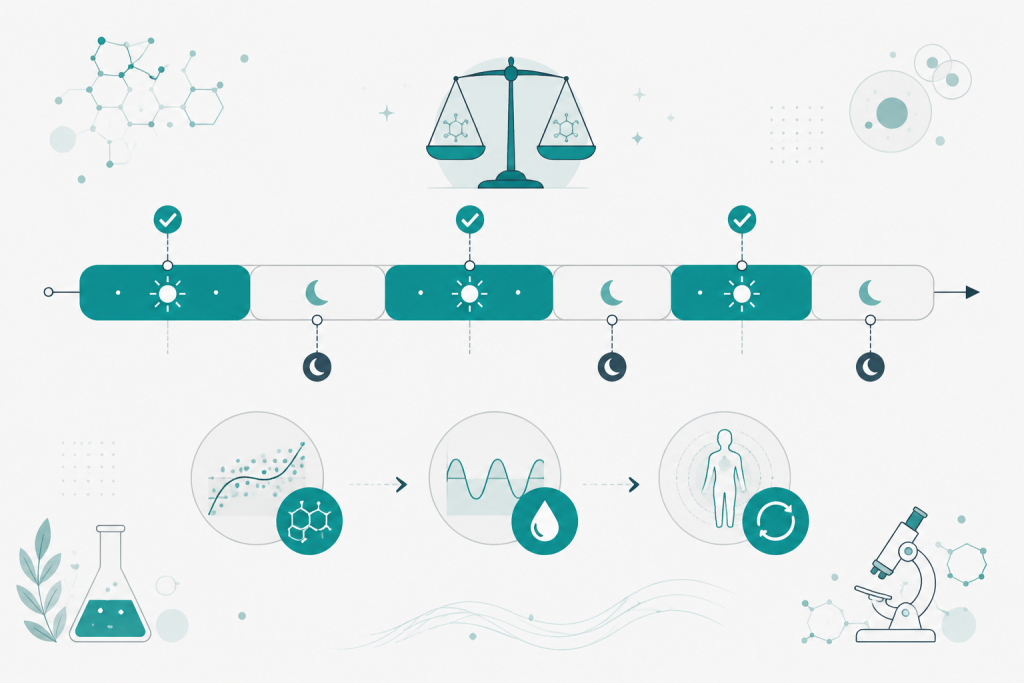
If you have spent any time reading bodybuilding forums or Reddit threads about anabolic steroids, you have almost certainly seen someone write “time on equals time off”. It sounds like a simple calendar rule, but the idea behind it is more about recovery than scheduling. This article explains what the phrase means, why some users use it as a rough baseline, and why bloodwork and symptoms matter more than the calendar alone.
- “Time on equals time off” means that the weeks spent using suppressive anabolic compounds are matched by an equal number of weeks completely off them before another cycle is considered.
- The aim is to allow the hypothalamic-pituitary-gonadal axis, liver markers, lipid profile, and cardiovascular measures time to move back towards an individual baseline.
- It is a harm-reduction guideline, not a medical prescription; bloodwork and symptoms matter more than the calendar alone.
What Does ‘Time On Equals Time Off’ Mean?
Definition of the time-on/time-off principle in steroid cycling
At its simplest, the rule says: however many weeks you spend “on” a cycle, spend at least that many weeks “off” before starting again. If you run an eight-week cycle, the rule calls for eight weeks off; twelve weeks on would mean twelve weeks off. Some users count the off phase from the point at which the active compounds have substantially cleared, rather than from the date of the last injection.
“Off” generally means using no suppressive anabolic steroids, SARMs, or prohormones. For some people it includes a post-cycle therapy protocol; for others it means a period without either exogenous hormones or additional drugs. In either case, the intention is to give the body time away from the compounds it has been exposed to.
Why this rule exists: receptor recovery and hormonal homeostasis
Anabolic-androgenic steroids can act through androgen receptors in muscle and other tissues. Exposure to external androgens also creates negative feedback in the hypothalamus and pituitary gland. As a result, luteinising hormone and follicle-stimulating hormone may fall, reducing the testes’ own testosterone production.
Remaining “on” without a break can maintain this suppression. Time off may allow the hypothalamic-pituitary-gonadal axis and other measures to move towards an individual baseline, although the extent and speed of recovery vary. Blood pressure, haematocrit, liver enzymes, and cholesterol can also change during a cycle, so an off phase is not a guarantee that these markers will return to normal.
How it differs from PTO in workplace contexts
It is easy to hear “time off” and picture a holiday. Workplace PTO is paid time away from a job. In steroid cycling, “off” refers to the absence of exogenous hormones, not a break from self-care. A person may still be training, eating, sleeping, and arranging medical follow-up or blood tests.
How Long Should You Wait Between Cycles?
The 1:1 rule explained: 12-week cycle = 12-week break minimum
The 1:1 ratio is a common shorthand. A twelve-week cycle is matched with a twelve-week break, while an eight-week cycle is matched with at least eight weeks off. It is better viewed as a rough minimum than as a reliable recovery timetable. Endocrine recovery and changes in other health markers do not follow a fixed schedule.
One detail matters for long esters: testosterone enanthate and cypionate may remain active for some time after the last injection. Some users therefore count the off phase from the point at which blood levels have fallen, rather than from the date of the final injection. The timing depends on the compound, dose, and individual response.
When longer breaks may be required
Calendar maths is only a starting point. More time off may be needed if bloodwork shows:
- Total or free testosterone still below the pre-cycle baseline
- LH and FSH remaining very low or clearly suppressed
- Elevated liver enzymes such as ALT or AST
- A lipid panel still outside the reference range, particularly low HDL or high LDL
- High haematocrit or blood pressure remaining above the usual level
- Persistent symptoms such as low libido, fatigue, mood changes, or poor sleep
Recovery may also take longer in women and older users. The same may apply after using multiple compounds, higher doses, or oral agents that affect liver enzymes and lipids.
Real-world examples from 8-week, 12-week, and 20-week cycles
These examples show how the 1:1 shorthand is commonly applied:
- Eight-week cycle: Often described as an oral-only or short-ester cycle. The shorthand suggests at least eight weeks off, but follow-up bloodwork may show that more time is needed.
- Twelve-week testosterone cycle: The usual benchmark for the rule. With long esters, the interval between the final injection and meaningful assessment may extend beyond the nominal break.
- Twenty-week cycle: A longer period of suppression. The 1:1 rule suggests twenty weeks off, but recovery may take longer after a five-month cycle, particularly if markers remain abnormal.
Do All Steroid Users Follow Time On Equals Time Off?
Community perspectives: when users deviate from the rule
No, not everyone follows it. Online discussions show a wide range of approaches. Some users treat the 1:1 rule as a firm boundary and extend their breaks if bloodwork is abnormal. Others treat it as flexible, especially if they feel well. The problem with relying on how you feel is that markers such as haematocrit or LDL can be outside the reference range without obvious symptoms.
Cruise protocols vs full breaks
One common deviation is the “blast and cruise” approach. Instead of coming completely off, a user runs a higher-dose “blast” for several weeks, then drops to a lower dose of testosterone for a “cruise”.
From a hormonal standpoint, this is not a complete break. The HPTA may remain suppressed because exogenous testosterone is still present. Lipids, haematocrit, and cardiovascular measures may change at lower doses, but this is not equivalent to a period without exogenous hormones. The risk profile is different, so the time-on/time-off rule does not apply in the same way.
SARMs vs traditional AAS: why time-on/time-off applies differently
Selective androgen receptor modulators are sometimes marketed as “mild” or “less suppressive”, but they can still affect LH, FSH, and testosterone. Depending on the compound and dose, they may also affect liver enzymes and lipids.
For that reason, the time-on/time-off principle is also relevant to SARMs. The degree and duration of suppression may differ between compounds and individuals, so the length of an off phase cannot be inferred from the calendar alone.
How to Know Your Body Has Recovered Before the Next Cycle
Bloodwork timing: weeks 6-8 post-cycle as a checkpoint
Six to eight weeks after the last active dose can provide a useful checkpoint, but it is not a universal recovery window. The timing of a meaningful blood test depends on the ester or compound used, the duration of exposure, and individual response. With long esters or prolonged cycles, a later assessment may be more informative.
You can see our guide to post-cycle bloodwork markers for a deeper look at what each value means. The key point is to compare post-cycle numbers with your own pre-cycle baseline, rather than with a generic internet average.
Key markers to check
- Total and free testosterone: Are they back in your usual range?
- LH and FSH: These pituitary hormones indicate whether signalling to the testes has resumed.
- Estradiol: Levels outside the usual range may be associated with symptoms and may warrant clinical review.
- Liver enzymes (ALT, AST): Particularly relevant after oral cycles.
- Lipids (HDL, LDL, triglycerides): AAS can shift these values.
- CBC / haematocrit: Exogenous androgens can raise red blood cell mass.
- Prolactin and SHBG: These may be useful when recovery appears unusually slow.
What to do if recovery is incomplete at the expected time-off mark
If bloodwork at the six-to-eight-week mark still looks abnormal, more time off may be needed. A clinician can advise on whether and when to repeat the tests. During that period, focus on sleep, nutrition, body composition, stress management, and other lifestyle factors that support general health.
If you used post-cycle therapy and still feel suppressed, discuss the timing and contents of that protocol with a clinician. There is no universal approach, and individual recovery varies widely.
Starting another cycle while markers remain abnormal may prolong suppression and add to cardiovascular or endocrine concerns. The calendar rule is only a rough minimum; bloodwork and clinical assessment provide a more useful basis for judging recovery.
Common Cycle Lengths and Their Required Breaks
The table below shows how the 1:1 rule is commonly applied to different cycle lengths. These are rough minimums, not guarantees of recovery; longer breaks may be needed when bloodwork remains abnormal.
| Cycle length | Common compounds | Minimum time off | Notes |
|---|---|---|---|
| 8 weeks | Orals, short esters | 8 weeks | Follow-up testing may be particularly relevant for liver enzymes and lipids. |
| 12 weeks | Testosterone enanthate/cypionate | 12 weeks | A common benchmark; the timing of assessment may extend beyond the nominal break because of ester clearance. |
| 16 weeks | Testosterone plus one or two injectables | 16+ weeks | Longer exposure may mean a longer recovery period; bloodwork is needed to assess individual response. |
| 20+ weeks | Extended bulking or cutting stacks | 20+ weeks | Recovery may be prolonged, so the nominal ratio may not reflect the time required. |
Shorter cycles do not automatically remove the need for an off phase. Even a four-week oral cycle may suppress natural testosterone production or affect liver enzymes and lipids. Dose, compound, and individual response all matter, so the 1:1 principle should not be treated as a fixed rule.
This article is for informational purposes only and is not a substitute for professional medical advice, diagnosis, or treatment. Talk to a qualified healthcare provider before using any anabolic steroids, SARMs, or related compounds, especially if you have existing health conditions, take medications, or are planning a family. Individual recovery varies, and nothing in this guide promises a specific outcome for you.