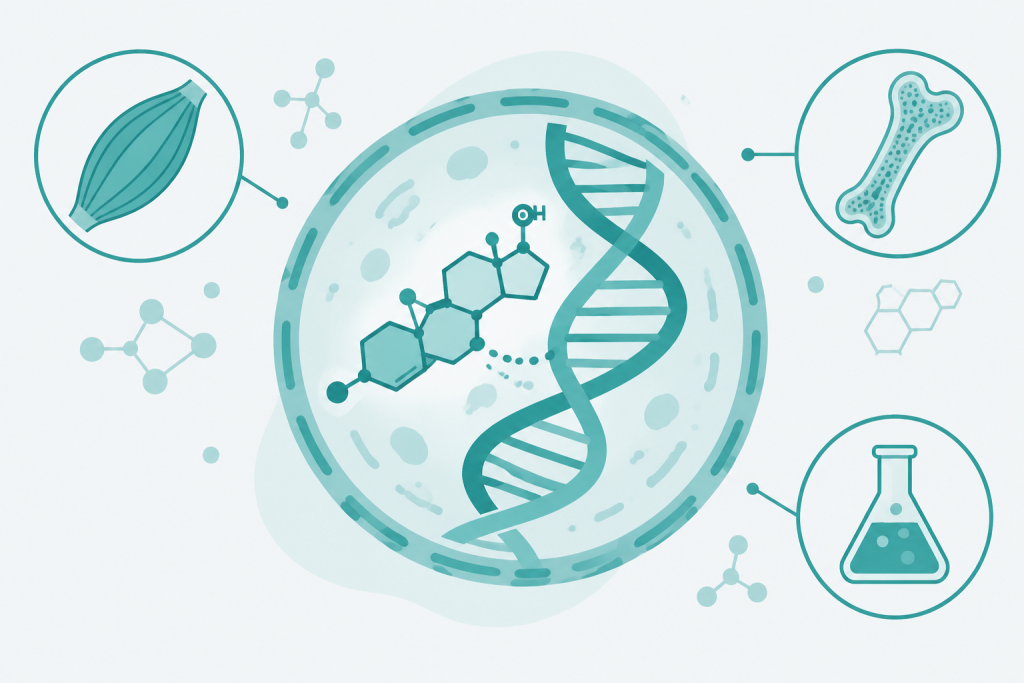
Testosterone gets a lot of attention in fitness circles, but much of that discussion skips the basic biology. Before you can make sense of lab results or understand why certain compounds behave the way they do, you need to know what this hormone does in the body day to day. This overview provides a reference point for understanding the underlying physiology, without sales claims or scare tactics.
- Testosterone supports protein synthesis, binds to androgen receptors, and influences gene expression in both sexes.
- In men, it shapes puberty, helps maintain muscle and bone, supports sperm production, and affects fat distribution.
- In women, it is present at lower levels but still contributes to bone strength, muscle maintenance, and libido.
- Both low and high levels can produce noticeable physical changes, so understanding the baseline can help put laboratory results into context.
What Testosterone Does in the Body: Core Functions
At its core, testosterone is an androgen — a steroid hormone built on a cholesterol backbone. Its primary role is signalling. It influences what cells build, how they grow, and how they maintain themselves. The main mechanisms are outlined below.
Role in Protein Synthesis and Tissue Growth
One of the best-established roles of testosterone is its involvement in protein synthesis. When testosterone reaches muscle tissue, it can promote the assembly of amino acids into new proteins. This process contributes to muscle repair after training and to tissue growth. When androgen signalling is inadequate, the rate at which the body builds and repairs structural proteins may fall. Testosterone’s anabolic effects are thought to involve increased activity in several protein-synthesis pathways.
Interaction with Androgen Receptors and Nuclear Receptors
How does a hormone circulating in the blood change a cell’s behaviour? Testosterone crosses the cell membrane and binds to intracellular androgen receptors. Once bound, the hormone–receptor complex moves into the cell nucleus. There, it acts as a transcription factor, attaching to specific regions of DNA and influencing whether certain genes are expressed. This genomic pathway can take time to produce visible effects, but its effects may persist because it changes the proteins produced by the cell. Some testosterone also converts locally into dihydrotestosterone (DHT), which binds to the same receptors with higher affinity and may produce stronger androgenic signalling in tissues such as the prostate and hair follicles.
Differences Between Males and Females
Both men and women produce testosterone, but typical circulating concentrations differ substantially. In males, the testes are the primary production site, under the influence of luteinising hormone (LH) signals from the pituitary gland. Adult male serum levels are often reported within a broad range of roughly 300 to 1,000 ng/dL. In females, the ovaries and adrenal glands produce testosterone, resulting in much lower baseline levels. Despite the difference in concentration, the hormone also has physiological roles in women. Its effects depend on the tissues involved, receptor activity, and the amount circulating.
What Does Testosterone Do for Men
For men, testosterone is the main circulating androgen, influencing development from before birth through later life. Its specific roles in male physiology include the following.
Development During Puberty
The rise in testosterone during puberty contributes to the transition from childhood to adulthood. It promotes the growth of facial, chest, and pubic hair, thickens the vocal cords and lowers the voice, and contributes to enlargement of the penis and testes. It also supports the initiation of spermatogenesis. These developmental changes result from androgen exposure alongside other hormonal and physiological processes.
Muscle Mass Regulation and Hypertrophy
Beyond puberty, testosterone continues to influence lean mass. It can shift the balance between muscle protein synthesis and breakdown towards net growth. This does not mean testosterone builds muscle without mechanical stimulus: resistance training provides an important trigger, while androgen status is one of several factors affecting the adaptive response. Higher physiological levels may support greater hypertrophy potential than deficient levels.
Bone Density Maintenance
Bone is constantly remodelled. Osteoblasts build new bone while osteoclasts break down old tissue. Testosterone supports osteoblast activity directly and indirectly, partly through conversion into oestrogen, which also contributes to male bone health. Adequate androgen activity helps maintain mineral density and skeletal structure during adulthood.
Sperm Production and Sex Drive
Intratesticular testosterone concentrations must remain considerably higher than serum levels to support spermatogenesis. Sertoli cells within the testes rely on this local supply while nurturing developing sperm. Testosterone also influences libido through pathways in the central nervous system. Lower androgen levels may coincide with reduced sexual desire, although psychological, relationship, and general health factors also contribute.
Fat Distribution Patterns
Men generally carry less subcutaneous fat than women, particularly around the hips and thighs. Testosterone influences where adipose tissue accumulates, and lower androgen levels are often associated with greater abdominal fat. Excess adipose tissue contains aromatase enzymes, which convert some testosterone into oestrogen and may further alter the hormonal balance.
What Does Testosterone Do for Women
Testosterone receives less attention in discussions of female endocrinology, but it also has roles in women’s health and physiology.
Physiological Roles in Female Bodies
In women, testosterone acts both as a hormone in its own right and as a precursor. It can be converted locally into oestrogen via aromatase, contributing to the overall oestrogen pool. It also has direct androgenic effects in tissues with androgen receptors, including muscle, bone, brain, and skin. The ovaries and adrenal glands provide a relatively low circulating supply, which varies across the lifespan.
Bone Strength and Muscle Tissue Maintenance
As in men, androgens contribute to skeletal health in women. After menopause, changes in oestrogen and androgen levels can occur alongside other factors associated with bone loss. Testosterone also contributes to the maintenance of lean mass, which is relevant to physical function and metabolic health as women age.
Libido and Sexual Function
Very low testosterone levels in women may be associated with reduced sexual desire. Although oestrogen has a central role in female reproductive physiology, androgens also contribute to sexual interest and function. The relationship is not linear: higher testosterone does not necessarily produce a proportional increase in libido, and sexual desire is influenced by many physical, psychological, and relationship factors.
Natural Levels Compared to Men
To put the difference in perspective, a healthy young woman might have total testosterone levels between 15 and 70 ng/dL, whereas a healthy young man might sit between 300 and 1,000 ng/dL. These ranges vary by laboratory and individual factors, but the difference helps explain why testosterone has distinct effects at typical female and male concentrations.
What Happens When Testosterone Levels Are Low
When production falls below what tissues require, the effects can involve several body systems. The changes below are possible findings rather than a basis for diagnosis on their own.
Changes in Muscle Strength and Mass
Hypogonadism and age-related decline may be associated with reductions in lean body mass. Some people notice decreased grip strength, slower recovery between workouts, or difficulty maintaining previously achieved muscle size. Reduced androgen signalling is one possible contributor to these changes.
Effects on Bone Density
Prolonged deficiency may disrupt the balance of bone remodelling. If osteoclast activity exceeds new bone formation over time, mineral density can fall. This process may remain unnoticed until it is identified through bone-density testing or after a fracture.
Shifts in Fat Distribution
Declining testosterone is often associated with greater central adiposity. Visceral fat may be linked with changes in metabolic health and with further disruption of the hypothalamic–pituitary–gonadal axis. The relationship is complex and can involve both hormonal and lifestyle factors.
Impact on Sex Drive and Sperm Production
In males, low testosterone may present as fewer morning erections, lower spontaneous desire, and fertility difficulties related to impaired spermatogenesis. These symptoms overlap with other conditions, so symptom tracking alone cannot establish the cause.
Signs That Warrant Evaluation
Persistent fatigue that cannot be explained by sleep quality, uncharacteristic mood changes, noticeable loss of muscle despite consistent training, or a sustained drop in libido may justify blood tests. These symptoms are not specific to low testosterone, so assessment should rely on appropriate laboratory testing and clinical evaluation rather than assumptions based on forum posts.
What Does High Testosterone Do
Higher levels are not necessarily better. Supraphysiological levels, whether endogenous or exogenous, can produce a different set of physiological responses. The effects depend on the level, duration, and context.
Effects of Elevated Testosterone in Men
Levels within the upper part of a normal reference range do not necessarily indicate a problem. Supraphysiological concentrations, particularly those associated with exogenous administration, can trigger negative feedback. The pituitary may reduce LH and FSH secretion, suppressing natural testosterone production and spermatogenesis. Other possible effects include increased red blood cell production, changes in lipid profiles, and greater sebaceous gland activity, which may contribute to acne.
Signs of High Testosterone in Women
Because typical female concentrations are lower, elevated androgen exposure can produce visible androgenic effects. Hyperandrogenism in women, including that associated with conditions such as polycystic ovary syndrome (PCOS), may present as hirsutism, male-pattern hair loss, acne, menstrual irregularities, and sometimes clitoral enlargement.
Physiological Changes Above Normal Ranges
Above-normal testosterone can affect nitrogen balance and red blood cell production. Chronically elevated haematocrit may have cardiovascular implications and requires clinical monitoring. Changes in liver enzymes depend heavily on the route of administration and the molecular structure of the compound involved, rather than on testosterone alone.
Comparing High Versus Low States
The table summarises some commonly associated differences. These are broad patterns, not diagnostic criteria, and individual responses vary.
| Parameter | Low Testosterone State | High / Supraphysiological State |
|---|---|---|
| Muscle Mass | Lower lean mass and more difficulty retaining it | Greater protein-synthesis signalling and hypertrophy potential |
| Body Fat | Greater tendency towards visceral or abdominal accumulation | Body-composition changes may occur, depending on context |
| Bone Density | Potentially increased bone remodelling and lower mineral content | Effects vary with concentration, duration, and aromatisation |
| Erythrocytes | Mild anaemia is possible in some cases | Raised haematocrit and blood viscosity may occur |
| HPT Axis Feedback | LH/FSH may rise in primary testicular failure | LH/FSH may be suppressed through negative feedback |
| Libido | Sexual desire and function may decline | Variable; effects may change with oestrogen conversion and other factors |
How Testosterone Levels Change
Testosterone is not a fixed number stamped on a chart at birth. It varies across the day and over the lifespan, so any individual laboratory result needs to be interpreted in context.
Factors Affecting Production
Age is one of the more predictable influences. Male testosterone generally peaks in early adulthood and tends to decline later, although estimates vary across populations. Sex affects the typical baseline range. Health status can also introduce short-term variation: systemic illness, caloric restriction, psychological stress, and poor sleep may suppress the hypothalamic–pituitary–testicular axis. Time of day matters as well; morning samples often capture higher secretion than evening samples.
Lifestyle Influences Documented in Research
Several modifiable factors have been associated with testosterone concentrations in observational and interventional research. Resistance training can temporarily raise circulating levels after a session, while longer-term resting changes depend on training design and recovery. Adequate nutrition, sufficient sleep, and management of chronic stress support normal endocrine function, although they cannot be assumed to correct pathological hypogonadism. The size and persistence of any change vary between individuals.
Testosterone Boosters: Claims vs. Documentation
The supplement market offers many products labelled as “testosterone boosters”. Ingredients such as fenugreek, ashwagandha, D-aspartic acid, and zinc appear frequently. Zinc is most relevant when a deficiency is present; correcting that deficiency may restore normal function but does not necessarily raise levels beyond the normal range. Some studies of ashwagandha and other ingredients have reported changes in stress markers or hormone measurements in specific groups, but those findings do not establish a consistent effect for all users. Evidence for fenugreek and D-aspartic acid also varies by product, population, and study design.
Most over-the-counter formulas do not contain pharmaceutical-grade androgens. Their ingredients are generally marketed as supporting normal endocrine function, but product quality, doses, and evidence differ. If testosterone levels are clinically low, supplements should not be assumed to address the underlying cause. Understanding androgen pathways still requires attention to dose, delivery method, and individual physiology.
This guide provides a physiological framework for interpreting blood results and understanding why different compounds may produce different effects. Testosterone acts through several interconnected systems, so laboratory values and symptoms need to be considered together rather than read through marketing claims.
This article is strictly informational and does not constitute medical advice. Nothing here should be interpreted as a recommendation to start, stop, or modify any substance use. If you have questions about your hormone levels, consult a licensed healthcare provider before making decisions — especially if you are pregnant, nursing, taking prescription medications, or managing a chronic health condition. Individual responses to hormonal fluctuations vary enormously, and reading about biological mechanisms does not predict what will happen in your specific case. Always rely on professional testing and clinical guidance rather than online references alone.