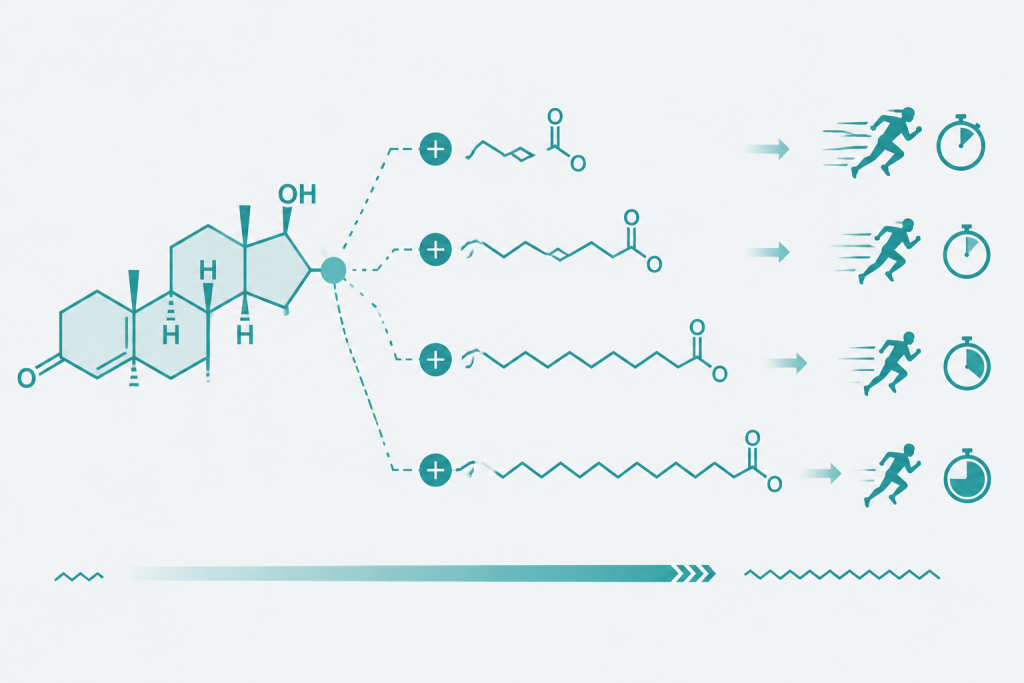
If you’ve ever read a testosterone label, you’ve seen words like enanthate, cypionate, propionate, or undecanoate written right after the hormone name. These are not different hormones. They are esters—small chemical tails attached to the same testosterone backbone—and they are the main reason one testosterone preparation behaves differently from another. In this article, we explain what steroid esters are, why they can change half-life, and how the most common testosterone esters compare in practice.
Understanding this distinction matters whether you are reading bloodwork, comparing products, or simply trying to understand why one person injects twice a week while another injects once a month.
- A steroid ester is a fatty acid chain attached to testosterone that makes the hormone more fat-soluble and slows its release into the blood.
- Longer ester chains generally release more slowly and are associated with longer half-lives, ranging from less than a day to several months in some preparations.
- Half-life is the time it takes blood levels to drop by half, and it is one of the main reasons injection schedules differ between esters.
What Are Esters in Steroids?
In organic chemistry, an ester is formed when a carboxylic acid reacts with an alcohol. When this reaction happens at the 17β-hydroxyl group of testosterone, the result is an esterified testosterone molecule. The testosterone core stays the same, but a fatty acid chain is now attached to it. This chain can be short, like the two-carbon acetate group, or very long, like the eleven-carbon undecanoate group.
The attached chain is lipophilic, meaning it dissolves much more readily in fat and oil than in water. After an intramuscular injection, the esterified testosterone forms a depot in the muscle tissue. From there, it enters the bloodstream only gradually. Once in circulation, enzymes called esterases cleave off the fatty acid chain through hydrolysis, releasing free testosterone that can bind to androgen receptors and exert its effects.
Before that cleavage, the esterified molecule has little direct activity at androgen receptors. This is why esterified testosterone is often described as a prodrug: a compound that is administered in one form and then converted into the active substance inside the body. The ester does not change what testosterone does; it changes when and how much testosterone becomes available at any given moment.
Without esterification, testosterone has a very short half-life. Native testosterone is quickly metabolised, and blood levels can rise and fall within hours. Early medical attempts to use unmodified testosterone injections found that this made stable hormone levels difficult to maintain. Esterification helped address the problem by creating a reservoir in the muscle that releases the hormone over time. The size of that reservoir and the speed at which it drains depend on the ester and the formulation.
This prodrug approach is not unique to testosterone. Many medicines use esterification to change how long they last or how well they are absorbed. In the steroid world, however, the ester has become a defining feature of many injectable testosterone products.
Esterified testosterone is not active at androgen receptors until the ester chain is removed. The half-life of an ester reflects the combined effects of release and hydrolysis, rather than the duration of action of free testosterone itself.
How Esters Affect Half-Life
The relationship between ester size and half-life is a general pattern in steroid pharmacology, although it is influenced by the formulation and route of administration. In broad terms, a larger and longer ester chain makes the molecule more lipophilic, which can slow its departure from the injection depot and extend its half-life. A short ester tends to leave more quickly, while a long ester tends to leave more slowly.
Several factors contribute to this pattern. First, the added fatty acid chain increases the molecular weight of the compound and reduces its water solubility. The more oil-soluble the molecule, the more it tends to remain in the lipid environment of the muscle rather than dissolving into the bloodstream. Second, the larger molecule may diffuse more slowly through tissue and be taken up by the blood at a lower rate. Third, once the esterified testosterone reaches the blood, hydrolysis may occur more slowly for larger esters because the esterase enzymes are acting on a larger substrate.
The practical range is wide. Short esters such as acetate can have half-lives of less than one day. Medium esters such as enanthate and cypionate are usually measured in days. Long esters such as decanoate can last one to two weeks, while some preparations of undecanoate have much longer terminal half-lives. This range is why the same hormone can be used in protocols involving daily injections, weekly injections, or less frequent administration.
There is another practical effect: the ester chain adds weight to the molecule, so each milligram of testosterone enanthate or cypionate contains slightly less actual testosterone than a milligram of unesterified testosterone. The longer the ester, the larger this difference. This does not change the half-life directly, but it matters when comparing doses across esters. A 100 mg dose of testosterone propionate contains more testosterone by mass than 100 mg of testosterone undecanoate because the undecanoate molecule carries a heavier tail.
Published half-life values are population averages, not personal guarantees. Individual clearance depends on factors such as body-fat percentage, injection site, local blood flow, liver and kidney function, enzyme activity, and other medicines. Two people using the same ester at the same dose can have noticeably different blood levels.
The oil used for injection can also play a role. Thicker oils and larger injection volumes may slow absorption further, while shallow or subcutaneous injections may release the drug differently from deep intramuscular injections. These practical variables mean that two injections of the same ester can behave differently depending on the formulation and technique.
Testosterone Esters: Half-Life Comparison
The table below summarises how the most commonly discussed testosterone esters compare. Carbon-chain length is a useful starting point for understanding why half-life often increases as the ester grows, but it does not determine the full pharmacokinetic profile on its own.
| Ester | Carbon chain length | Commonly cited half-life | Typical injection interval |
|---|---|---|---|
| Testosterone acetate | 2 carbons | Less than 1 day | Daily or every other day |
| Testosterone propionate | 3 carbons | ~1 day | Every 1–2 days |
| Testosterone isocaproate | 6 carbons | ~4–7 days | Weekly |
| Testosterone enanthate | 7 carbons | ~4–5 days | Every 5–7 days |
| Testosterone cypionate | 8 carbons | ~4–7 days | Every 7 days |
| Testosterone decanoate | 10 carbons | ~7–10 days | Weekly or less often |
| Testosterone undecanoate | 11 carbons | 150+ days (longest-acting preparations) | Varies by route and preparation |
Short esters: acetate and propionate
Acetate and propionate are among the shortest testosterone esters commonly discussed. Because their fatty acid chains contain only two or three carbons, they generally leave the muscle depot and undergo hydrolysis relatively quickly. Blood levels can rise and fall over a short period, so maintaining more consistent levels may require more frequent injections.
Propionate has been used since the 1930s and is still referenced frequently. Its roughly one-day half-life means that injections every one to two days are often discussed in athletic contexts. A shorter ester may be cleared more quickly than a longer one if treatment is stopped, although the exact time depends on the preparation and the individual.
Medium esters: enanthate and cypionate
Enanthate and cypionate are widely used testosterone esters in hormone replacement therapy and performance-oriented protocols. Both have half-lives of roughly four to seven days, which makes weekly or twice-weekly injections practical in some regimens. They are often treated as interchangeable, and the difference is generally small.
Enanthate has a seven-carbon chain and is commonly cited with a half-life of about four to five days. Cypionate has an eight-carbon chain and is often described as lasting slightly longer, though published ranges overlap considerably. The extra carbon in cypionate makes the molecule marginally more lipophilic, but diet, body composition, and injection technique may have a greater impact on actual blood levels than the one-carbon difference.
Long esters: decanoate, isocaproate, and undecanoate
Decanoate, isocaproate, and undecanoate extend the release window further. Decanoate is often found in testosterone blends such as Sustanon, where it provides a longer-acting component. With a half-life often cited around one to two weeks, it can contribute to background levels while shorter esters provide earlier exposure.
Undecanoate is among the longest-acting testosterone esters in widespread use. Injectable preparations can maintain clinically relevant levels for months in some protocols, while oral undecanoate behaves differently because it is absorbed through the lymphatic system and avoids first-pass liver metabolism. The 150+ day figure sometimes cited for undecanoate reflects slow terminal elimination in certain preparations, rather than the time required for all biological activity to stop.
For a complete reference on how different compounds compare in duration and how to work with half-life data, see our comprehensive ester guide.
What Half-Life Actually Means
Half-life is a simple concept with important practical consequences. It is defined as the time required for the concentration of a substance in the blood to decrease by 50%. If a testosterone ester has a five-day half-life and your trough level is 800 ng/dL, then roughly five days later—without another injection—you would expect the level to be around 400 ng/dL. After another five days it would be around 200 ng/dL, and so on.
This pattern is exponential, not linear. The hormone does not disappear after two half-lives; small amounts can remain detectable for much longer, especially with large esters. What the half-life tells you is the speed of the decline, which is a key variable when considering injection timing.
The concept also explains steady state. When you inject repeatedly, levels accumulate because each new dose arrives before the previous one has fully cleared. Eventually, the amount entering the body between injections approaches the amount leaving, and blood levels stabilise. This steady state is usually reached after about four to five half-lives. For propionate, that means roughly one week; for enanthate, it means roughly three to four weeks; for the longest esters, it can take months.
Half-life also affects how long it takes to adjust or stop a protocol. If levels are too high, a short ester may decline substantially within days, while a long ester may take weeks to fall towards baseline. This is one reason injection frequency and the timing of blood tests need to be considered together.
It is also useful to distinguish between an apparent half-life and a terminal half-life. The apparent half-life is the value estimated from the observed concentration–time profile under particular conditions. The terminal half-life describes the slower final phase of elimination. For some long esters, the terminal half-life can be much longer than the earlier decline, which is why traces may remain detectable after subjective effects have changed.
When interpreting blood tests, timing matters. A level drawn right before an injection (trough) will look very different from a level drawn a day or two after an injection (peak). Comparing two blood tests without knowing where they fall in the injection cycle can be misleading, especially with long esters where the peak-to-trough difference may be smaller but the absolute timing still matters.
Pharmacokinetic studies of testosterone esters, including absorption rates and elimination profiles, have been reviewed in publications such as this PMC review.
This article is for informational and educational purposes only. It is not a medical recommendation, diagnosis, or treatment plan. The way any testosterone ester behaves in your body can differ from published averages because of metabolism, body composition, health status, and other factors. Talk to a qualified healthcare provider before making any decisions about hormone use, especially if you are pregnant, breastfeeding, taking medications, or have a chronic medical condition. We do not promise any specific result for any individual reader.