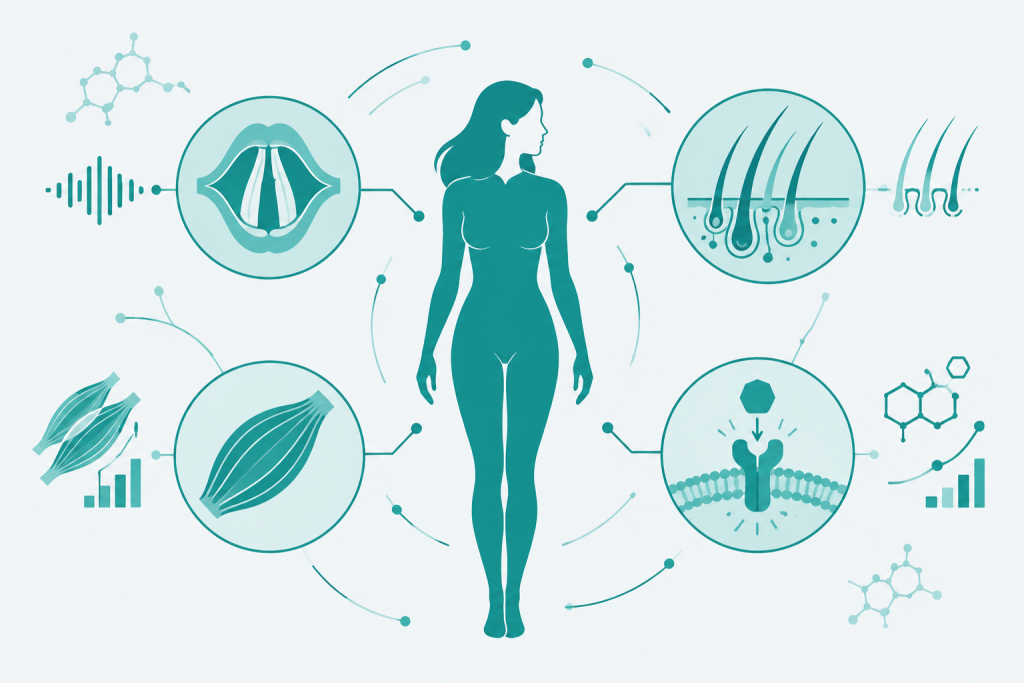
Virilization is a term you will often see in discussions about anabolic steroids, hormone therapy, and rare endocrine disorders. In simple terms, it describes the appearance of male-typical physical traits in a female body. For women exposed to anabolic steroids, it is an important potential adverse effect to understand, because some changes can be slow to reverse and a few may be permanent.
- Virilization is the development of male-typical traits in females, driven by excess androgen activity.
- Anabolic steroids can cause it in women because they introduce synthetic or exogenous androgens into the body.
- Some effects, such as acne or cycle changes, may reverse after stopping use; voice deepening and clitoral enlargement often persist.
- Anyone noticing these changes should seek medical advice promptly and discuss the suspected cause with an endocrinologist or gynaecologist.
What Is Virilization in Females?
Virilization is the clinical term for the development of male-typical physical traits in a female body. It can occur when tissues are exposed to more androgen activity than the female endocrine system normally produces. The androgens most relevant here are testosterone and its more potent metabolite, dihydrotestosterone (DHT). In healthy women, the ovaries and adrenal glands make small amounts of these hormones, and that production is tightly regulated. When androgen activity rises, androgen-sensitive tissues may begin to change.
Clinicians often reserve the word virilization for a recognisable syndrome rather than a single change. A woman with mild acne and a slightly deeper voice is not necessarily described as virilised, but when several male-typical features appear together—especially hair growth, voice change, and genital changes—doctors use the term more specifically.
Virilization vs. masculinisation
Masculinisation is the broader, descriptive term. It refers to any process that makes a body look or function more like a typical male body. Virilization is the medical term used when excess androgen signalling produces a pattern of masculinising changes. In other words, all virilisation is masculinising, but not every masculine-looking trait represents medical virilisation. The distinction can help clinicians assess whether an underlying androgen excess needs evaluation.
Virilization vs. hirsutism
Hirsutism is excessive growth of coarse, dark, terminal hair in places where men usually grow hair: the upper lip, chin, chest, abdomen, back, and thighs. It can be driven by androgens, but it is only one piece of the puzzle. Virilization includes hirsutism plus other changes such as voice deepening, male-pattern baldness, clitoral enlargement, severe acne, and menstrual disruption. If a woman has only unwanted hair without other signs, clinicians usually call it isolated hirsutism rather than full virilisation.
| Feature | Hirsutism | Virilization |
|---|---|---|
| Definition | Excess male-pattern hair growth | Syndrome of masculinising physical changes |
| Hair changes | Present | Present, but only one component |
| Voice changes | Absent | Can occur |
| Genital changes | Absent | Can occur (clitoromegaly) |
| Typical causes | PCOS, mild androgen excess, genetics | Adrenal disorders, anabolic steroids, tumours |
How androgens trigger virilization
Androgens exert their effects by binding to androgen receptors inside target cells. When receptor activation remains high, it can alter the activity of genes involved in tissue structure and function. In the larynx, this may thicken the vocal cords and lower the voice. In hair follicles, it can convert fine vellus hair into thick terminal hair and, on the scalp, shrink follicles and produce male-pattern thinning. In genital tissue, it can promote clitoral growth. The outcome depends on the dose, duration of exposure, the specific androgen or steroid, and the individual’s receptor sensitivity.
What Causes Virilization in Females?
Virilization is not a diagnosis by itself; it is a sign that androgen exposure may be too high. The source of that exposure can be inside the body or come from a drug or supplement.
Adrenal gland disorders
Endogenous causes include conditions that make the adrenal glands produce too many androgens. Congenital adrenal hyperplasia (CAH), adrenal adenomas, and adrenal carcinomas are classic examples. CAH is usually identified in childhood, but milder, late-onset forms can surface in adolescence or adulthood. Androgen-secreting adrenal tumours may produce testosterone, DHEA-S, or related hormones. Because some of these tumours can be serious, sudden or severe virilization warrants medical assessment.
Anabolic steroid use
Anabolic-androgenic steroids are synthetic derivatives of testosterone. When a woman uses them, she adds an external source of androgens to a system that normally keeps these hormones relatively low. The added signal can push androgen-sensitive tissues towards masculinising changes. This is an exogenous cause: the hormones come from outside the body rather than from the ovaries or adrenals.
Testosterone supplements and other medications
Other exogenous sources include testosterone gels or injections used for low libido, menopausal symptoms, or gender-affirming care. Older drugs such as danazol, and some over-the-counter supplements marketed for muscle or energy, have also been associated with androgenic effects. Occasionally, products sold as “natural” contain undeclared synthetic androgens. Any substance that raises circulating androgens may contribute to virilization.
Why virilization is generally not diagnosed in males
The term virilization is generally not used for men because they already have male-typical androgen levels and anatomy. High androgens in men can certainly cause problems—acne, gynaecomastia, infertility, prostate enlargement, and cardiovascular concerns—but they do not usually produce male traits as a new, abnormal phenomenon. Virilization is most useful as a term when female-typical physiology is pushed towards male-typical development.
Signs and Symptoms of Virilization in Females
The signs of virilization vary in speed and severity. Some women notice changes within weeks of starting an androgenic substance; others develop them gradually. The most characteristic features are listed below.
- Voice deepening. Androgens can increase the mass and length of the vocal cords, producing a lower, rougher voice. This is one of the most noticeable effects and also one of the least likely to reverse on its own.
- Facial and body hair growth. Coarse hair may appear on the upper lip, chin, chest, abdomen, back, and thighs. This overlaps with hirsutism, but in virilization it is usually accompanied by other signs.
- Male-pattern baldness. Androgens can trigger thinning at the crown and a widening part. Women rarely become fully bald, but the thinning can be persistent.
- Clitoral enlargement. Known medically as clitoromegaly, this results from direct androgen stimulation of genital tissue. It can be accompanied by discomfort or increased sensitivity, and significant enlargement often persists after the drug is stopped.
- Menstrual changes or cessation. High androgens can suppress the hypothalamic-pituitary-ovarian axis, leading to irregular periods, lighter bleeding, or amenorrhoea. Fertility may also be impaired.
- Increased muscle mass and body composition changes. Because anabolic steroids can promote muscle protein synthesis, women may gain lean mass and lose fat in certain areas. This change is not necessarily harmful by itself, but it indicates androgen exposure and may coexist with the other features above.
Severe acne and oily skin are also common early signs. They may appear before more persistent changes develop, making them a possible warning sign.
Can Women Develop Virilization from Anabolic Steroids?
Yes. Anabolic-androgenic steroids can cause virilization in women because they introduce exogenous androgens into a relatively low-androgen environment. It is a recognised potential adverse effect in female users.
How anabolic steroids introduce exogenous androgens
All anabolic-androgenic steroids interact with the androgen receptor to some degree. Some compounds are marketed as more “anabolic” (muscle-building) and others as more “androgenic” (masculinising), but the separation is not clean. A steroid with a low androgenic rating can still bind to receptors in the skin, hair follicles, larynx, and genitals if the dose is high enough or the individual is sensitive enough.
Risk factors: dose, duration, and type
Higher doses may increase the likelihood of virilization. Longer exposure gives tissues more time to remodel. Compounds derived from dihydrotestosterone (DHT) tend to bind strongly to scalp and skin receptors and may accelerate hair loss and acne. For context, see our detailed breakdown of specific compounds and their androgenic ratings.
Why female users are especially at risk
Women naturally have far lower baseline testosterone than men. Their androgen receptors may therefore be exposed to a larger relative increase in signalling when an exogenous androgen is added. Tissues such as the larynx, hair follicles, sebaceous glands, and genitals are particularly responsive.
Permanence of certain effects
Which changes reverse and which persist depends on the tissue. Effects that rely on ongoing hormone exposure—such as oily skin, acne, and menstrual irregularities—often improve after the drug is stopped. Effects that involve structural remodelling, especially voice deepening and clitoromegaly, are much less likely to return to baseline. Stopping exposure earlier may reduce the likelihood of permanent changes.
A review of anabolic steroid use in women published in PMC identifies virilization as a frequently reported adverse effect and notes that the persistence of symptoms varies by individual and compound. Another review discusses the clinical spectrum of androgen excess in women, including the distinction between hirsutism and true virilization.
Virilization Treatment and Reversibility
Treatment focuses on removing the source of excess androgens, managing symptoms, and assessing any underlying condition.
Stopping anabolic steroid use
If anabolic steroids are the cause, a clinician may advise stopping them. Once the exogenous androgen is no longer being taken, the body’s own hormone production may gradually recover and circulating androgen levels may fall. Natural production can be suppressed, so recovery may take weeks or months rather than days.
Surgical options for adrenal or ovarian tumours
When virilization is caused by an adrenal adenoma, adrenal carcinoma, or androgen-secreting ovarian tumour, surgery to remove the tumour may be considered. Imaging studies and hormone panels can help the medical team locate the source and plan the procedure.
Which symptoms may reverse and which remain persistent
- Often reversible: Menstrual cycles may return, although this can take months. Acne and oily skin commonly improve. New hair growth may slow, although hair that has already become terminal may require cosmetic removal.
- Often persistent: Voice deepening and significant clitoromegaly are the least likely to reverse without surgical intervention. Hair thinning may also persist.
Medical monitoring during treatment
Because virilization can signal a serious medical condition, evaluation is important. Clinicians may measure total and free testosterone, DHEA-S, androstenedione, LH, FSH, and possibly 17-hydroxyprogesterone. If levels are high or the onset is rapid, imaging of the ovaries and adrenal glands may be ordered. Follow-up testing can track recovery and help assess whether an underlying tumour has been missed.
Bottom Line
Virilization is the development of male-typical traits in a female body driven by excess androgen exposure. Anabolic steroids are a recognised exogenous cause. Some effects may reverse after stopping the drug, but voice deepening and clitoral enlargement often persist. If you notice these changes, seek medical advice promptly and discuss the suspected source with an endocrinologist or gynaecologist.
Important: This article is for informational purposes only and is not a substitute for professional medical advice, diagnosis, or treatment. If you are considering or currently using anabolic steroids, testosterone, or any hormone-related product, speak with a qualified healthcare provider first. This is especially important if you are pregnant, planning pregnancy, taking other medications, or have a chronic health condition. Individual responses vary, and we do not promise any specific outcome for any reader.