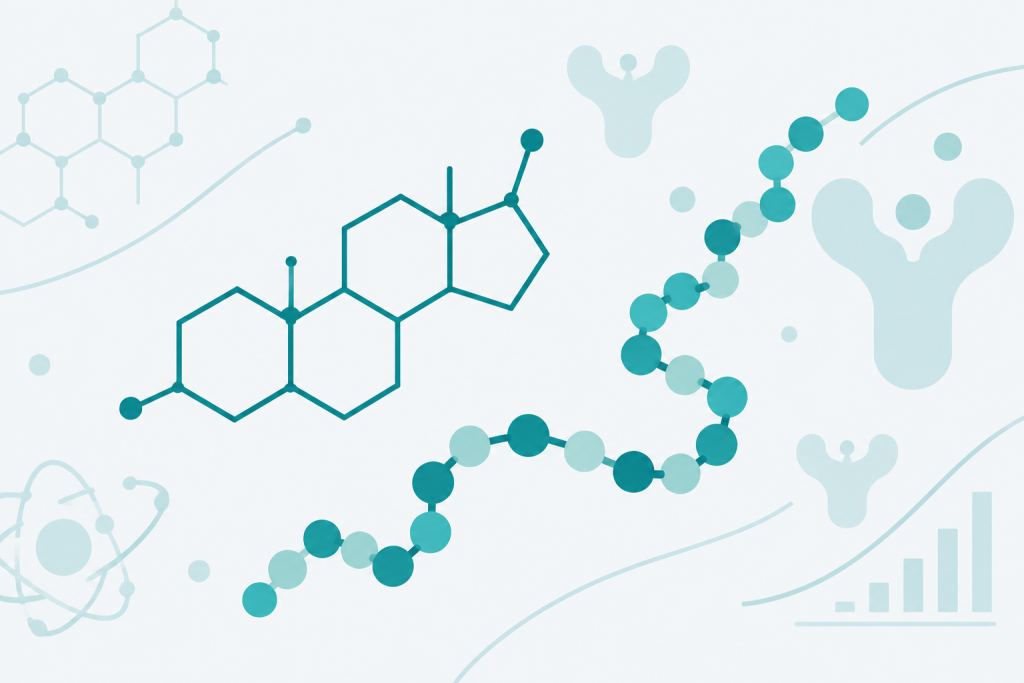
If you’re trying to make sense of performance-enhancing compounds, the first point to clarify is that “anabolic steroids” and “peptides” are not two versions of the same thing. They belong to different chemical families, act through different pathways, and have different risk profiles. The comparison below outlines how they differ and why the legal and safety context matters.
- Steroids are synthetic androgen derivatives that bind directly to androgen receptors; peptides are short amino-acid chains that send hormonal signals.
- Steroids provide testosterone-like activity, while peptides may influence the body’s own hormone output rather than supplying an androgen directly.
- Peptides are often viewed as milder, but they are not risk-free and are not automatically legal for casual human use.
- SARMs sit somewhere in between: they target androgen receptors more selectively than steroids but still lack long-term human safety data.
What Are Anabolic Steroids and Peptides: Chemical Structure and Core Differences
Anabolic steroids are synthetic derivatives of testosterone and related androgens. Their core structure is a four-ring carbon skeleton—the same steroid nucleus found in cholesterol, testosterone, and oestrogen. The skeleton is made of three six-carbon rings and one five-carbon ring fused together. Because this structure is lipophilic, steroid molecules pass through cell membranes and bind to intracellular androgen receptors. Common examples include testosterone esters, nandrolone, boldenone, trenbolone, and dihydrotestosterone derivatives such as stanozolol or oxandrolone. Individual steroids differ in potency, aromatisation, and tissue selectivity, but their effects generally involve activation of the androgen receptor and changes in gene expression.
Peptides, on the other hand, are short chains of amino acids linked by peptide bonds. They are not steroids and do not contain a steroid ring system. In practical terms, a peptide is anything from a few amino acids up to several dozen; once the chain becomes much longer, it is usually classified as a protein. In the sports pharmacology context, “peptides” usually refers to signalling molecules that may influence hormone release, recovery, or metabolism. Examples include growth-hormone secretagogues such as GHRP-2, GHRP-6, and ipamorelin; growth-hormone-releasing hormone analogues such as CJC-1295; IGF-1-derived peptides; and compounds like BPC-157 or TB-500 that are discussed in connection with tissue repair. Rather than entering cells and binding DNA-associated receptors, many peptides bind to receptors on the cell surface and trigger signalling cascades that change cellular behaviour.
| Feature | Anabolic steroids | Peptides |
|---|---|---|
| Chemical backbone | Four-ring steroid nucleus | Chain of amino acids |
| Primary target | Intracellular androgen receptor | Membrane receptors; often pituitary or hypothalamic signals |
| How they act | Mimic or supplement natural androgen signalling | Signal the body to release or respond to hormones |
| Common examples | Testosterone, nandrolone, trenbolone, oxandrolone | Ipamorelin, CJC-1295, BPC-157, IGF-1 LR3 |
| Relation to hormones | Direct hormone analogues | Hormone-releasing or signalling fragments |
The key distinction is structural: a compound built around a steroid skeleton is a steroid, while one made from amino acids is a peptide. That difference helps explain why the two classes have different mechanisms and side-effect profiles.
Mechanism of Action: Direct vs Indirect Anabolic Effects
Anabolic steroids provide synthetic testosterone-like activity. Once inside target cells, they bind to the androgen receptor, translocate to the nucleus, and alter gene expression. This can increase protein synthesis, nitrogen retention, red-blood-cell production, and satellite-cell activity. The stimulus is direct: the steroid molecule activates the anabolic pathway rather than relying on the body’s own testosterone production. The scale and speed of any resulting changes vary with the compound, dose, duration, and individual response.
Peptides do not provide androgens. Instead, some act as signalling molecules that influence the body’s own hormone production. A growth-hormone secretagogue, for example, binds to the ghrelin receptor or related receptors in the hypothalamus and pituitary, prompting a pulse of growth hormone. Growth hormone can then act on the liver and other tissues, including through IGF-1 production. The peptide is one step removed from this downstream activity: it initiates a signal, but the body still has to respond with its own hormones. Some peptides, such as IGF-1 LR3, act more directly through IGF receptors, so the distinction is not absolute. They are nevertheless not steroids and do not supply testosterone.
This distinction—direct versus indirect—is central when comparing the two classes. Steroids provide an exogenous anabolic stimulus; peptides may modulate endogenous anabolic signals. The direct route can produce a stronger and more consistent signal in some contexts, but it can also interfere with the body’s normal feedback systems. The indirect route depends more heavily on the individual’s endocrine function and other factors, including sleep, nutrition, and training.
Because some peptides influence the body’s own hormone pulses, their effects may differ from those of exogenous androgens. Claims that changes supported by peptides are easier to maintain after discontinuation remain uncertain and should not be treated as a general expectation.
Safety Profile and Side Effects Comparison
When people call peptides “milder,” they usually mean that many peptides do not directly supply the body’s sex hormones. A testosterone-based steroid cycle introduces an external supply of androgens, which can suppress the hypothalamic-pituitary-gonadal axis and reduce natural testosterone production. Peptides that work through growth-hormone pathways generally do not suppress testosterone in the same way, so they may be less likely to cause some androgen-specific effects. Their risks depend on the individual compound and should be considered separately.
That does not make peptides harmless. Depending on the specific peptide, possible issues include water retention, joint pain, increased hunger, insulin resistance, numbness or tingling in the extremities, elevated prolactin or cortisol, and injection-site reactions. There are also theoretical concerns about stimulating pre-existing lesions when growth-hormone activity is raised, although direct evidence in healthy users is limited. Because many research peptides are sold as unregulated chemicals, purity and dosing accuracy are additional practical risks. A vial labelled with one compound may contain something else entirely, or may be under- or over-dosed.
Neither anabolic steroids nor peptides are risk-free. If you are considering any of these compounds, you should speak with a qualified medical professional first. Self-administering research chemicals or prescription hormones without supervision can lead to serious and sometimes irreversible health problems.
Steroid side effects are well documented and can include acne, accelerated hair loss, gynaecomastia, testicular atrophy, infertility, elevated blood pressure, adverse lipid changes, cardiovascular strain, liver stress with oral 17-alpha-alkylated compounds, and mood disturbances. Some effects resolve after discontinuation; others, such as cardiovascular remodelling or fertility impairment, may be long-lasting.
Over the long term, the risks and practical consequences differ between individuals and compounds. Steroid-related changes may recede when use ends, particularly if natural hormone production has been suppressed. The effects of peptide use also vary, and limited regulation can make both the contents and the dose uncertain. Training, nutrition, sleep, and appropriate medical advice remain relevant regardless of the substance being considered.
Legal Status: Are Peptides Legal and How Do They Compare to Steroids
The legal position differs between countries and between individual compounds. In the United States, testosterone and some anabolic steroids are Schedule III controlled substances; in the United Kingdom, anabolic steroids are Class C drugs. The rules on possession, importation, supply, and prescription use are not identical, and importing or supplying controlled steroids without the required authority can carry criminal penalties. This status reflects their recognised medical use as well as concerns about misuse.
Peptides occupy a more complicated space. Many of the compounds discussed in bodybuilding circles—GHRPs, CJC-1295, BPC-157, TB-500, and IGF-1 derivatives—are not approved for human use in major markets and are sold as research chemicals not intended for human consumption. Some peptides, such as sermorelin or tesamorelin, are approved for specific medical indications and require a prescription. In sport, the World Anti-Doping Agency prohibits a long list of peptide hormones, growth factors, and related substances, regardless of whether they are prescription or research-grade.
So the question “are peptides legal?” does not have a single answer. It depends on the exact compound, the country, whether it is prescribed, and whether the user is subject to anti-doping rules. Peptides are not automatically legal simply because they are “not steroids.”
The legal distinction matters for anyone researching these substances. Buying unregulated research peptides online means dealing with uncertain labelling, unknown purity, and no quality oversight. Buying controlled steroids without the required prescription or authority may expose the user to legal penalties as well as medical risks. Understanding the classification of each compound is part of responsible research.
Peptides vs Steroids vs SARMs: Where Each Fits in Performance Enhancement
Selective androgen receptor modulators, or SARMs, are often grouped with steroids and peptides in online discussions, but they form a third category. Like anabolic steroids, SARMs bind to androgen receptors; unlike most steroids, they are designed to be tissue-selective, with a preference for muscle and bone over prostate, skin, and hair follicles. In practice, that selectivity is partial, and many SARMs can still suppress natural testosterone production. They are also predominantly unapproved research chemicals and are banned in competitive sport.
| Aspect | Anabolic steroids | Peptides | SARMs |
|---|---|---|---|
| Primary target | Androgen receptor, widespread | Membrane receptors; hormone signals | Androgen receptor, more selective |
| Anabolic effect | Strong and direct | Indirect and modulatory | Moderate and tissue-targeted |
| Testosterone suppression | Strong, dose-dependent | Usually minimal to none | Mild to moderate, compound-dependent |
| Typical uses discussed | Muscle mass, strength, recovery | Recovery, fat loss, sleep, GH support | Muscle gain, fat loss, bridging |
| Legal status | Controlled substances in most jurisdictions | Varies; many are research-only or prescription-only | Mostly unapproved research chemicals; controlled in some places |
In practical terms, the three categories are discussed in connection with different aims. Steroids provide a direct anabolic stimulus and can carry a substantial side-effect burden. Peptides are discussed in relation to recovery, injury repair, sleep quality, fat metabolism, and hormone signalling, although evidence and regulatory status vary considerably between compounds. SARMs are often presented as a middle ground—more direct than peptides and less broadly active than traditional steroids—but their long-term human safety data remain limited.
Any decision about these substances depends on the individual’s health, goals, risk tolerance, and whether they are tested for sport. There is no universally “best” choice, and anyone seeking more information about individual compounds and their side-effect profiles can explore our dedicated compound guides. A qualified physician with relevant experience in endocrinology or sports medicine can help explain the health implications.
This article is for informational and educational purposes only. It is not medical advice, diagnosis, or treatment recommendation. Before using any peptide, hormone, or research chemical, consult a qualified healthcare provider, especially if you are pregnant, taking prescription medications, or managing a chronic health condition. We do not promise any specific outcome, and individual responses to these substances vary widely.