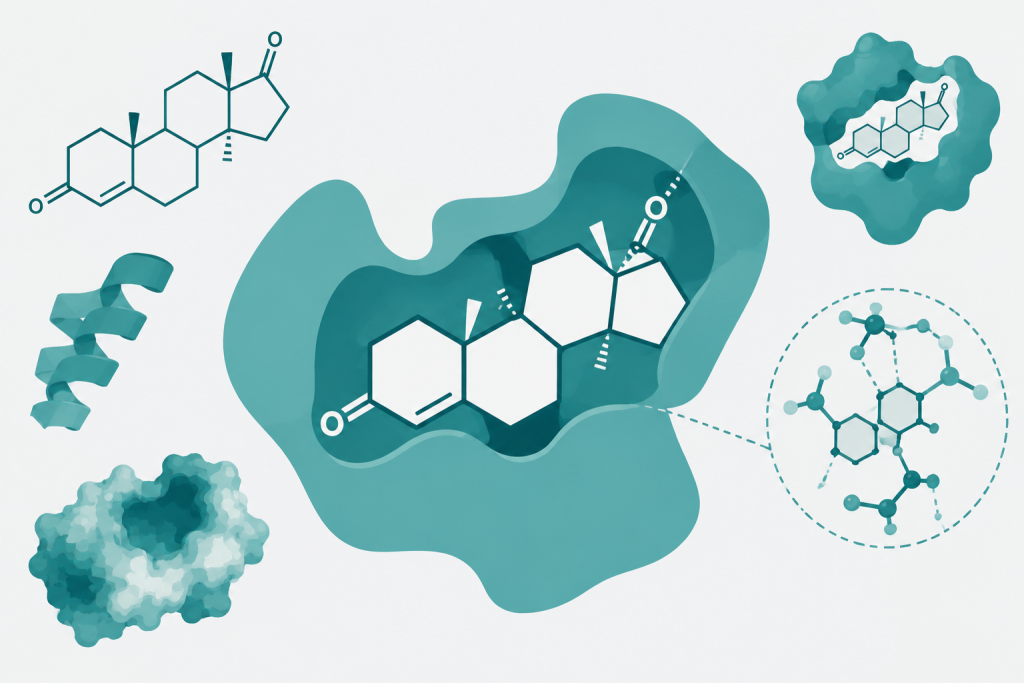
When people compare anabolic-androgenic steroids, ‘potency’ is one of the first words they encounter. One compound is called ‘mild,’ another ‘strong,’ and a third is said to be ‘many times more powerful.’ These labels are hard to interpret because potency means one thing in a pharmacology textbook and something else in a training log. In this article, we explain what steroid potency actually measures, why it varies from compound to compound, and why the potency label alone is a poor way to judge either results or risk.
- Potency is a dose-response idea: it tells you how much compound is needed to trigger a given androgen-receptor-mediated effect. It is not the same as total results or safety.
- Binding affinity and molecular design—methylation, esterification, ring modifications, and resistance to breakdown—help explain why compounds can appear stronger or weaker.
- Testosterone is the usual 1:1 reference point; other compounds are positioned relative to it, but animal-ratio data rarely translates directly to humans.
- In real use, dose, route, individual genetics, training, nutrition, and recovery often matter more than any published potency ranking.
What Is Steroid Potency?
Definition of potency in the context of AAS
In pharmacology, potency is the dose or concentration needed to produce a specific biological effect. For AAS, the relevant effect is usually activation of the androgen receptor and the downstream signalling that influences protein synthesis, nitrogen retention, and other anabolic processes. A steroid that produces the same receptor activation at a lower dose is considered more potent. This does not mean it is better, safer, or more appropriate for a particular goal; it simply means less material is needed to reach a given level of receptor engagement.
How potency differs from efficacy and total effect
Potency and efficacy are separate concepts. Efficacy is the maximum biological response a compound can produce once it fully activates its target. Two steroids may have different potencies but similar efficacy ceilings; the weaker one just needs more milligrams to get there. Total effect depends on dose, cycle length, route, training stimulus, protein intake, sleep, recovery, and individual physiology. A compound with lower published potency can therefore produce a larger real-world outcome than a higher-potency compound if the overall protocol is better.
The role of receptor binding affinity
Binding affinity is one factor that contributes to potency. It describes how tightly a steroid molecule fits into the androgen receptor and stabilises the receptor–ligand complex. A tighter fit generally means a lower concentration is enough to trigger the same signalling response. However, binding affinity measured in a test tube does not account for what happens inside the body. Much of the steroid in circulation is bound to SHBG, some is converted in the liver, and some becomes metabolites with different activities. A compound with excellent affinity can still have a limited effect if it is rapidly cleared or heavily bound.
Why Are Some Steroids Stronger Than Others?
Molecular structure and modifications
Most AAS are built on the four-ring testosterone skeleton. Medicinal chemists alter that skeleton to change activity, survival, or route of administration. 17α-alkylation adds a methyl group that protects the steroid from rapid hepatic breakdown during the first pass, making oral administration practical but increasing liver stress. Esterification attaches a fatty acid ester to create a slow-release depot; this changes pharmacokinetics, not the intrinsic receptor activity of the parent hormone once cleaved. Ring modifications—adding, removing, or shifting double bonds and methyl groups—alter the molecule’s three-dimensional shape and therefore its fit with the receptor and its interaction with metabolic enzymes.
Androgenic vs anabolic activity ratio
The classic anabolic:androgenic ratio comes from animal assays. Testosterone is assigned a 1:1 baseline, and other compounds are compared by their effect on the levator ani muscle versus androgen-sensitive tissues such as the prostate and seminal vesicles. These ratios helped chemists screen molecules, but they are not a reliable guide for human use. A compound can look highly anabolic on paper while still producing androgenic side effects, because tissue selectivity in rodents differs from that in humans. The assays also ignore oestrogenic, progestogenic, cardiovascular, and neurological effects.
Resistance to metabolic breakdown
Effective exposure depends partly on how much active molecule survives metabolism and reaches the receptor. Structures that resist aromatisation, 5α-reduction, or glucuronidation may contribute to stronger effects at lower doses. The oral route illustrates this: without 17α-alkylation, oral testosterone would be largely destroyed during first pass, limiting its effect regardless of receptor affinity. Alkylation improves survival but introduces hepatic strain.
Conversion to other active metabolites
Steroids are substrates for enzymes that create active metabolites. Testosterone can aromatise to oestradiol and 5α-reduce to dihydrotestosterone. Nandrolone is reduced to dihydronandrolone, generally less androgenic than DHT. Trenbolone does not aromatise to oestrogen and displays strong progestogenic activity. These conversions shape net effect and side-effect profile; a metabolite may help in one tissue and cause problems in another.
Steroid Strength Comparison: Key Compounds
Testosterone remains the natural reference because the body already uses it as the primary androgen. In laboratory comparisons its anabolic and androgenic effects are normalised to a 1:1 baseline. Other compounds are described as more anabolic, more androgenic, or more tissue-selective relative to that baseline. The table below summarises the general picture qualitatively; it is not a prescription.
| Compound | Class / origin | Relative receptor affinity | Common notes |
|---|---|---|---|
| Testosterone | Natural androgen; esters are prodrugs | Baseline | The 1:1 reference; aromatises and 5α-reduces freely. |
| Nandrolone | 19-nortestosterone | Higher than baseline | 5α-reduces to a less androgenic metabolite; aromatises at a lower rate than testosterone. |
| Trenbolone | 19-nor; highly modified | Very high | Does not aromatise; strong progestogenic and androgenic activity. |
| Oxandrolone | DHT-derived oral | High relative to dose | 17α-alkylated for oral use; often described as milder in androgenic expression. |
| Stanozolol | DHT-derived oral or injectable | High | Does not aromatise; oral form is 17α-alkylated and hepatotoxic. |
| Methenolone | DHT-derived | Moderate | Often used at higher doses because of lower perceived potency and milder profile. |
For a detailed breakdown of individual compounds and their characteristics, see our main site.
Oral vs injectable forms
Oral and injectable steroids differ in effective exposure. Orals must survive hepatic first pass, so many are 17α-alkylated, which improves survival but can contribute to more pronounced peak–trough patterns depending on the compound and dosing schedule, as well as liver strain. Injectables, especially esterified forms, bypass first-pass metabolism and provide steadier blood levels. An oral compound with high receptor affinity can still be potent per milligram; the practical difference is usually consistency and risk profile, not raw receptor activity.
Common misconceptions about steroid potency rankings
- ‘More potent equals more gains.’ Not necessarily. Gains depend on total dose, cycle length, training, nutrition, and recovery.
- ‘The anabolic:androgenic ratio predicts real-world results.’ Ratios come from animal assays and ignore oestrogenic, progestogenic, and cardiovascular effects.
- ‘Orals are always weaker.’ Some oral compounds are extremely potent per milligram; duration and liver exposure are the main issues.
- ‘Potency and side effects move in lockstep.’ Androgenic sides may track with receptor strength, but oestrogenic and progestogenic sides depend on metabolism and structure.
How Potent Are Different Steroids in Practice?
Factors beyond molecular potency
In the real world, molecular potency is only the starting point. The same compound can feel different from person to person because of SHBG levels, receptor density, enzyme expression, body composition, age, and health. Low SHBG may mean a greater proportion of free steroid, while higher aromatase activity may mean more oestrogen. Route, frequency, ester, stacking, training, nutrition, sleep, and stress then influence whether the signal contributes to tissue growth.
Why potency alone does not determine results or risk profile
A potency ranking is a snapshot of one property. It does not capture tissue behaviour, metabolism, or individual tolerance. Two users on the same compound at the same dose can report very different outcomes. Risk is equally complex: androgenic sides may track with receptor affinity, but oestrogenic risks come from aromatisation, progestogenic risks from structure, and hepatotoxicity from 17α-alkylation.
The relationship between potency and side effect severity
The relationship between potency and side effects is loose, not linear. A potent compound at a conservative dose may cause fewer problems than a moderate compound used at a higher dose. A low-potency oral used long term can still raise liver enzymes. Monitoring may include blood work and checks of oestrogen, blood pressure, lipids, and liver markers. Potency helps explain chemistry, but it is not a shortcut for safety.
Informational notice. This article is intended for educational and reference purposes only. It is not a medical recommendation, diagnosis, or treatment plan. The effects of anabolic-androgenic steroids vary widely between individuals, and outcomes cannot be predicted with certainty. If you are considering any hormone-modifying compound, consult a qualified healthcare professional first—especially if you are pregnant, breastfeeding, taking medications, or have a chronic health condition.