What Are the Two Types of Steroids?
When people talk about “steroids” in sports or bodybuilding, they usually mean anabolic steroids. The word steroid, however, covers a large family of molecules, and not all of them affect muscle tissue. Two categories athletes and coaches commonly encounter are corticosteroids and anabolic steroids. Both are built on the same cholesterol-derived carbon skeleton, but they bind to different receptors and produce different effects in the body.
- Anabolic steroids are not the same as corticosteroids: they act on androgen receptors, not inflammatory pathways.
- Natural testosterone is the body’s own anabolic steroid; synthetic versions are chemically modified to change strength, duration, or route of administration.
- The main practical differences are origin, molecular structure, and how strongly a compound favours muscle-building activity over androgenic side effects.
Corticosteroids, such as cortisol and its pharmaceutical relatives, are commonly used to reduce inflammation and suppress immune responses. They mimic the action of hormones produced by the adrenal cortex. In medical settings they can help with asthma, allergies, autoimmune conditions, and similar problems. They are not used to build muscle; in fact, long-term or high-dose corticosteroid use is associated with muscle wasting, bone thinning, and fat redistribution.
Anabolic steroids, by contrast, are androgens. They bind to androgen receptors in tissues such as skeletal muscle, bone, and the reproductive organs. When activated, these receptors can increase protein synthesis, nitrogen retention, and the activity of satellite cells involved in muscle repair. That is why anabolic steroids are relevant to athletic performance and body composition: they can amplify physiological signals that normally respond to resistance training and adequate nutrition.
It is important to keep the two categories separate. Searching for information about muscle-building compounds and landing on corticosteroid pages can be confusing, and the risks and legal status of the two groups are very different. Someone reading about “steroid use” in athletics is almost always reading about the anabolic-androgenic group, not anti-inflammatory drugs.
Naturally Occurring Anabolic Steroids vs Synthetic Compounds
The primary natural anabolic steroid in humans is testosterone. In men it is produced mainly by the Leydig cells of the testes; women produce smaller amounts in the ovaries and adrenal glands. Testosterone is synthesised from cholesterol and has a characteristic four-ring structure shared by all steroid hormones. Because it is made inside the body, its concentration follows a daily rhythm and is tightly regulated by the hypothalamic-pituitary-gonadal axis.
Natural testosterone has a relatively short half-life in circulation, is partly converted to dihydrotestosterone by the enzyme 5-alpha reductase, and can be aromatised to oestradiol by aromatase. These conversions are normal parts of endocrine physiology and help regulate everything from bone density to mood. The balance between testosterone, DHT, and oestradiol matters: each has distinct roles, and the body adjusts conversion rates according to tissue-specific enzyme expression.
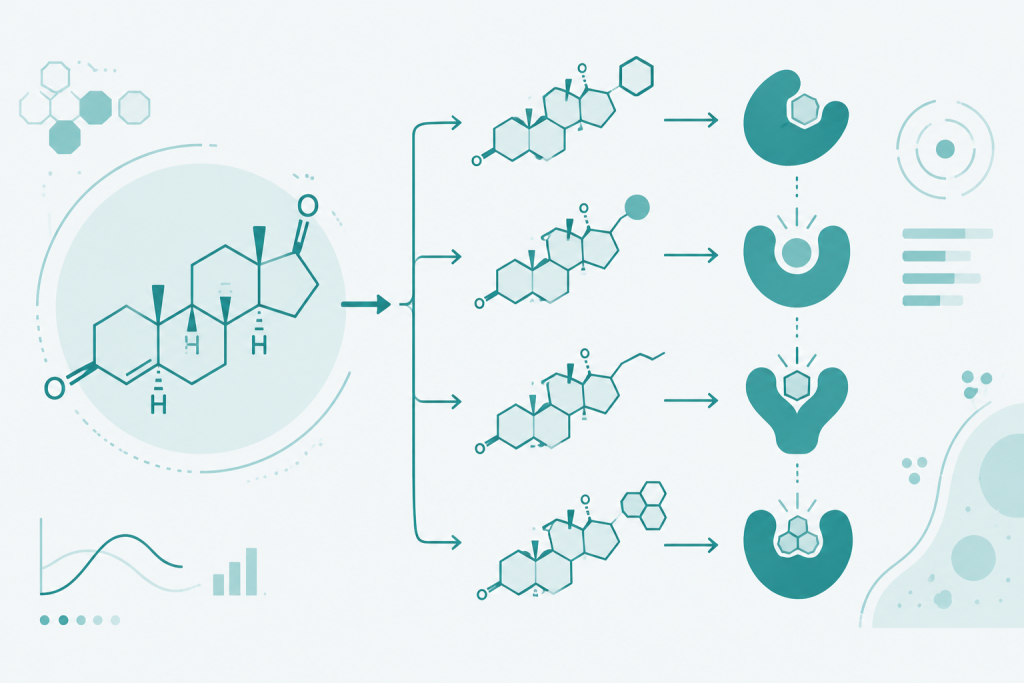
Synthetic anabolic steroids are compounds created in laboratories to replicate or modify the effects of testosterone. Most are direct chemical derivatives of testosterone or dihydrotestosterone. The aim is usually to produce a molecule that activates the androgen receptor strongly in muscle and bone while changing how long the compound lasts, how it is administered, and what side-effect profile it produces.
Common structural modifications include 17-alpha alkylation, which allows some compounds to survive the first pass through the liver and be taken orally; esterification of the 17-beta hydroxyl group, which slows release from injection sites and extends half-life; and alterations to the A-ring or removal of the 19-methyl group, which can change the balance between anabolic and androgenic activity. Each modification changes the way the molecule interacts with enzymes, receptors, and transport proteins such as sex hormone-binding globulin.
These changes are not cosmetic. A 17-alpha-alkylated oral steroid can stress the liver because it resists normal breakdown. A long-acting ester produces a slower rise and fall in blood levels. A non-aromatising compound cannot be converted to oestradiol, which removes some oestrogenic effects but can alter the ratio of androgens to oestrogens in ways that affect mood, lipids, and cardiovascular risk. Understanding the structure therefore helps explain some of the practical differences users and clinicians observe.
Are Anabolic Steroids the Same as Testosterone?
All anabolic steroids are related to testosterone, but they are not identical to it. Testosterone is the reference point used when measuring anabolic and androgenic potency: its effects define the baseline against which other compounds are compared. A compound may be described as more or less anabolic than testosterone, but that description always refers to relative activity, not a completely separate mechanism.
Synthetic analogues differ from endogenous testosterone in several ways. They may bind more tightly to the androgen receptor, resist breakdown by liver enzymes, remain active in the body longer, or avoid conversion to oestrogen or DHT. Some are designed to be more tissue-selective, although truly separating muscle-building effects from androgenic effects has proved difficult. The androgen receptor is the same across many tissues, so a drug that strongly stimulates muscle growth usually stimulates other androgen-sensitive tissues as well.
The terms anabolic and androgenic describe overlapping sets of actions. Anabolic effects include increased protein synthesis, greater nitrogen retention, enhanced bone density, and stimulation of red blood cell production. Androgenic effects include the development of facial and body hair, deepening of the voice, acne, sebum production, and growth of prostate tissue. Natural testosterone produces both sets of effects in proportions that reflect normal physiology.
Many synthetic compounds are engineered to shift the ratio towards anabolic activity. Laboratory animal assays historically compared the growth of specific muscles with the growth of androgen-sensitive tissues such as the prostate or seminal vesicles. A compound with a higher anabolic-to-androgenic ratio is expected to produce more muscle growth relative to androgenic side effects, but individual human response still varies and animal data do not always predict clinical outcomes. The ratio is a guide, not a guarantee.
Examples of Synthetic Steroids and Their Design
Several synthetic anabolic steroids are commonly discussed in medical literature, veterinary medicine, and sports contexts. Nandrolone is a 19-nortestosterone derivative. Removing the 19-methyl group changes its interaction with the androgen receptor and reduces some androgenic effects compared with testosterone. Stanozolol is derived from dihydrotestosterone and includes a pyrazole ring that prevents aromatisation. Oxandrolone is another oral DHT derivative known for a favourable anabolic-to-androgenic ratio in laboratory models. Methandienone, trenbolone, and boldenone are further examples, each with distinct structural features that influence half-life, route of administration, and metabolic fate.
These compounds are engineered to emphasise anabolic over androgenic effects, but the separation is never complete. A molecule that activates the androgen receptor in muscle will usually also activate it in skin, hair follicles, the prostate, and the brain. Some synthetic steroids avoid aromatisation, which removes oestrogen-related effects such as water retention and gynaecomastia, but may produce other issues such as negative lipid changes or increased cardiovascular strain. Others resist 5-alpha reduction, changing the intensity of androgenic side effects without eliminating them.
For readers who want to go deeper, our detailed breakdown of specific compound types and their effects covers individual agents and their pharmacological profiles.
| Feature | Natural testosterone | Synthetic anabolic steroids |
|---|---|---|
| Origin | Produced endogenously by the testes, ovaries, and adrenal glands | Manufactured in laboratories from steroidal precursors |
| Chemical structure | Unmodified testosterone with a four-ring steroid nucleus | Testosterone or DHT derivatives with added, removed, or altered chemical groups |
| Regulation in the body | Controlled by the hypothalamic-pituitary-gonadal axis and feedback loops | Administered exogenously; bypasses the body’s normal production controls |
| Half-life and administration | Short natural half-life; no external administration needed in healthy individuals | Variable half-lives depending on esters, oral modifications, and formulation |
| Metabolic fate | Aromatises to oestradiol and converts to DHT under normal physiological control | May resist aromatisation or 5-alpha reduction depending on the compound |
| Anabolic/androgenic ratio | Balanced anabolic and androgenic activity in normal physiology | Often engineered to favour anabolic effects, though androgenic effects remain |
| Legal/medical status | Prescribed as testosterone replacement therapy for diagnosed deficiency | Controlled substances in many jurisdictions; medical use is restricted and compound-specific |
| Primary context of discussion | Baseline hormone for health, reproduction, and normal muscle maintenance | Pharmacological agents used or studied in relation to muscle wasting, anaemia, and, outside medicine, athletic use |
One of the most visible differences is the timeline of effects. Natural muscle building depends on progressive resistance training, adequate protein intake, sleep, recovery, and genetic factors. Measurable changes in strength and size typically develop over months or years. Synthetic anabolic steroids can accelerate some underlying physiological responses, such as protein synthesis and nitrogen retention, which is why they are associated with faster changes in body composition. Those changes are not guaranteed, are not uniform across individuals, and carry recognised health risks discussed elsewhere in this article.
It is also worth noting that faster progress does not mean better long-term outcomes. Connective tissue, tendon strength, and movement patterns adapt more slowly than muscle mass. Rapid increases in load without corresponding connective-tissue adaptation can raise injury risk. This is one reason why neutral, evidence-based information matters.
Is There a Difference Between Natural and Synthetic Testosterone?
When people ask whether there is a difference between natural and synthetic testosterone, the answer depends on what exactly they mean. Chemically, pharmaceutical testosterone used in testosterone replacement therapy is usually bioidentical to the testosterone produced by the human body. Once in the bloodstream, the molecule itself does not know whether it was made in a laboratory or in the testes. The difference lies in the route of arrival and the regulatory context.
Endogenous testosterone production is pulsatile, follows circadian patterns, and is adjusted by feedback signals. The hypothalamus releases gonadotrophin-releasing hormone, the pituitary releases luteinising hormone, and the testes respond by producing testosterone. When levels rise, the brain reduces stimulation; when levels fall, production increases. This helps keep hormone levels within a range that fits the individual.
Exogenous testosterone, whether bioidentical or a synthetic analogue, overrides this feedback system. The body detects elevated hormone levels and suppresses, sometimes substantially, its own production. That is why external administration can lead to testicular atrophy, reduced fertility, and changes in oestrogen and DHT levels. The difference between endogenous and administered testosterone is therefore less about the molecule and more about the disruption of normal regulation.
The phrase natural steroid is also used loosely. Sometimes it refers to endogenous hormones such as testosterone. Sometimes it describes plant-derived sterols marketed as supplements. Sometimes it refers to prohormones, which are precursors the body can convert to active hormones. These categories are not interchangeable. A compound is not automatically safer because it is labelled natural, and a synthetic compound is not automatically more powerful simply because it is made in a laboratory.
Testosterone replacement therapy illustrates the distinction clearly. TRT supplies testosterone to men with diagnosed deficiency and is monitored with blood tests such as total and free testosterone, luteinising hormone, follicle-stimulating hormone, oestradiol, haematocrit, and lipid panels. The goal is restoration, not enhancement. Using the same hormone at supraphysiological doses for performance changes the risk profile because the body is no longer operating within its normal regulatory range.
The most useful way to think about the distinction is to separate the molecule from the context. Natural testosterone is part of a self-regulating system; synthetic compounds and administered testosterone enter that system from outside. That external entry is what changes risk, legality, and the pattern of side effects, regardless of whether the exact molecule is identical to the one the body makes.
Anabolic steroids and testosterone are controlled or prescription-only substances in many countries. Non-medical use carries documented risks, including cardiovascular strain, altered blood lipids, liver toxicity, endocrine suppression, infertility, mood changes, and skin problems. Anyone considering hormone-related treatment should consult a qualified clinician and have appropriate blood tests.
This article is for informational purposes only and is not a substitute for professional medical advice, diagnosis, or treatment. Talk to a licensed healthcare provider before making any decisions about hormones, medications, or supplements, especially if you are pregnant, taking prescription medicines, or managing a chronic condition. Individual results and responses vary, and nothing in this material promises a specific outcome for any reader.